





New Retractable Banner Stands and Trade Show Signage: A Buyer's Guide for DFW Events Post
Most retractable banner stands run 33 inches wide by 78 to 80 inches tall, the size that fits a standard 10x10 DFW trade show booth without crowding the space. Before anything else, check three things: an aluminum base with a real spring or geared retraction mechanism, a telescoping (not fixed) pole, and fabric graphics if you are exhibiting more than a handful of times a year. Fabric costs more up front but resists the creasing that ends most vinyl banners' useful life after a season of Metroplex trade shows.
What Is a Retractable Banner Stand?
A retractable banner stand, a portable display that stores a printed graphic inside a spring-loaded aluminum base and pulls it up a support pole for setup in under a minute. Release the pole and the graphic retracts back into the base for transport, which is the entire appeal of the format: no assembly tools, no loose panels to lose in a rental van, and a footprint small enough to check as luggage.
You will see the same product called a pull-up banner, a roll-up banner, or occasionally a roller banner. All three terms describe the identical spring-and-base mechanism. An X-banner stand is a different, cheaper category built around a lightweight X-shaped frame instead of a retracting base, and it is worth knowing the difference before you shop, since the two are frequently listed side by side.
Standard Banner Stand Sizes and What Fits Your Booth
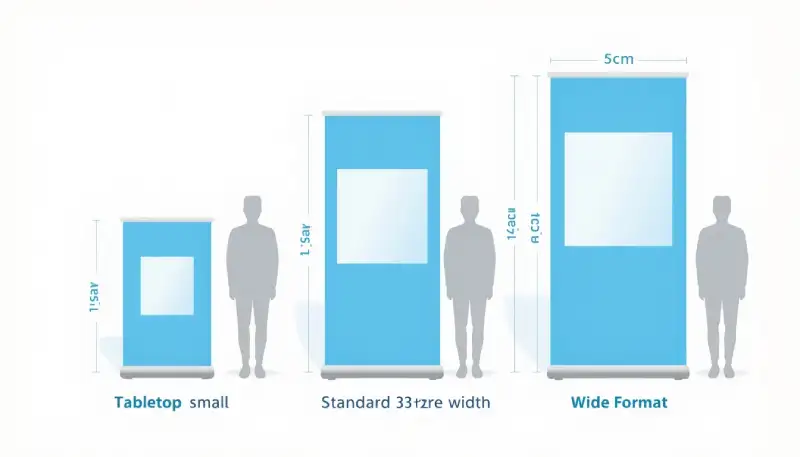
Banner stand width is really a booth-planning decision, not a graphic design one. A standard 10x10 DFW trade show booth, the most common footprint at venues like the Fort Worth Convention Center or the Kay Bailey Hutchison Convention Center in Dallas, comfortably holds one or two full-size stands without blocking sightlines to the rest of the display.
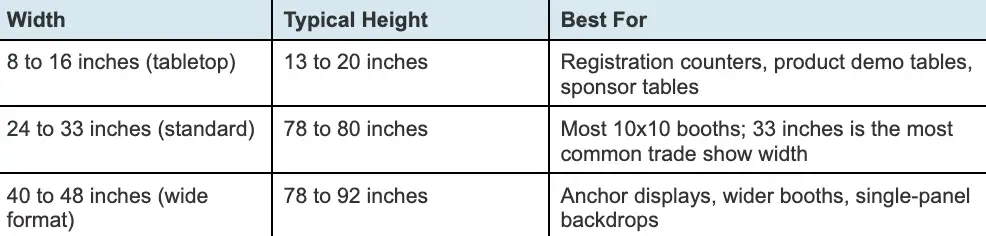
For a corner booth or an aisle-facing setup, two 33-inch stands flanking a table or backdrop usually reads better than one oversized stand, since it gives attendees two points of visual entry instead of one wall of graphics.
Vinyl vs. Fabric Graphics: Which Holds Up Better at Texas Trade Shows
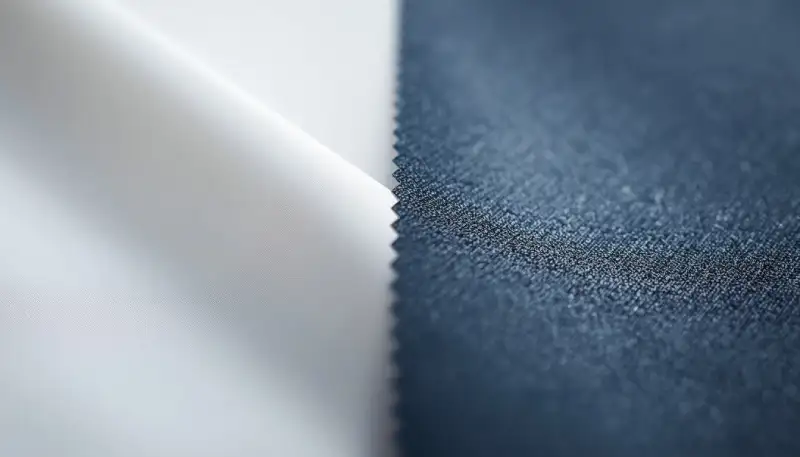
The graphic material affects how the stand looks on day one and how it looks on show twelve. Vinyl prints crisp, handles fine detail well, and costs less to reprint, which makes it the practical choice for a first stand or for messaging that changes every quarter. Its downside shows up over time: vinyl creases where it folds into the base, and in a Texas summer, a banner left in a hot vehicle or storage unit between events tends to develop a curl at the edges faster than it would in a milder climate.
Fabric graphics (usually dye-sublimation printed) resist that creasing almost entirely, since the material has more give than vinyl and does not hold a fold line the same way. The tradeoff is cost per reprint. For a business exhibiting at eight or more DFW events a year, fabric typically pays for itself in fewer graphic replacements. For an occasional exhibitor doing one or two annual shows, vinyl remains the sensible default.
Hardware Quality: What Separates a Stand That Lasts From One That Doesn't
Most banner stand failures happen in the base, not the graphic. A few specifics worth checking before you order:
Base mechanism: a geared or dual-spring retraction system holds tension far longer than a single lightweight spring, which tends to sag or stop retracting fully after a season of regular use.
Pole type: a telescoping pole adjusts to different graphic heights and booth configurations. A fixed pole locks you into one size for the life of the stand.
Leveling feet: show floor carpet, poured concrete, and outdoor pavement are rarely perfectly flat. Leveling feet keep the graphic from leaning, which matters more than most first-time exhibitors expect.
Carry case: a stand without a case travels the base and pole unprotected. A soft case is the baseline; a hard case is worth it for anything that flies to a show or rides in a shared vehicle.
Warranty: reputable manufacturers back the spring mechanism separately from the printed graphic. No stated hardware warranty is usually a sign of economy-grade
Setup, Storage and What Actually Shortens a Stand's Lifespan
Setup on a quality stand takes under a minute: extend the pole, pull the graphic up and hook it to the top, and adjust the leveling feet if the floor is uneven. Most damage happens at breakdown, not setup. Letting the graphic snap back into the base instead of guiding it down slowly stresses the spring over hundreds of cycles. Leaving a stand fully deployed between shows, rather than retracted, has the same effect, since the spring stays under constant tension instead of resting.
Storage matters as much as handling. A stand kept in a climate-controlled space between events holds its tension and graphic quality far longer than one left in a hot garage, a storage unit, or the back of a van through a North Texas summer. If your team exhibits on a regular schedule, building "retract fully, store flat, keep it cool" into the breakdown checklist is the single cheapest way to extend a stand's working life.
Designing Graphics People Actually Read From Across the Show Floor
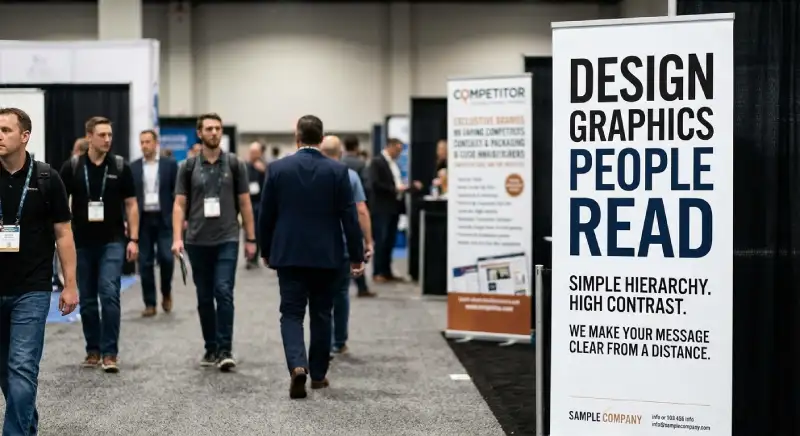
A banner stand only works if someone can read it while walking past at a normal pace. The most common design mistake is treating the panel like a printed flyer: too much text, too many competing headlines, and a logo that gets lost in the noise.
A useful test: stand back roughly twenty to twenty-five feet, about the width of a typical aisle, and see whether the core message is legible in three seconds. If it isn't, the text is too small, there are too many elements, or the contrast between text and background is too low. High-contrast pairings (dark text on a light background or vice versa) read from farther away than subtle brand-color-on-brand-color combinations, even when those combinations look sharp on a monitor up close.
Keep the hierarchy simple: company name and logo, one clear statement of what you do, and a single call to action. Everything else, from a QR code to a phone number, belongs in smaller supporting text below the fold of what a passerby reads at a glance.
Complementary Displays for a Complete DFW Booth
A banner stand rarely works alone. Most DFW exhibitors pair one or two stands with a step and repeat backdrop for photo moments and press coverage, plus a branded table cover for the counter where conversations actually happen. A step and repeat wall gives attendees, speakers, and local press a consistent backdrop for photos, which extends the booth's visibility well past the show floor once those photos get shared. A branded table cover does quieter work: it turns a folding table into part of the display instead of a piece of furniture someone brought from storage.
Both are worth planning at the same time as the banner order, since matching colors, fonts, and finishes across the booth reads as a coordinated brand rather than a collection of separate purchases made at different times from different vendors.
Indoor vs. Outdoor DFW Events: What Changes
Standard retractable banner stands are built for controlled indoor environments. Take one outdoor to a Fort Worth Main Street Arts Festival booth or a Sundance Square community event, and the spring mechanism is exposed to humidity, wind, and direct sun that it was not engineered for. Aluminum bases tolerate brief outdoor use but will warp or corrode with repeated exposure.
If your event calendar includes outdoor markets, festivals, or sidewalk promotions anywhere in the Metroplex, look for a stand specifically rated for outdoor use, with a weighted or water-fillable base and rust-resistant hardware. These stands cost more and weigh more, but a standard indoor stand used outdoors in North Texas wind typically fails within a single season.
Choosing a DFW Trade Show Signage Partner
A banner stand is one piece of a larger event presence, and the businesses that get the most out of one usually work with a local signage partner who can design, produce, and coordinate the full booth rather than a single product. Elevated Exposure Signs and Graphics, founded by Keith Mensah, who holds a Master's degree in City and Regional Planning, works with Fort Worth and Dallas-area businesses on event and tradeshow signage as part of a structured, compliant approach to commercial signage rather than a one-off print order. As a Texas HUB-certified company, Elevated Exposure also supports procurement requirements for organizations that need to document historically underutilized business participation in their vendor sourcing.
Frequently Asked Questions
What is the standard size for a trade show banner stand?
The most common trade show banner stand is 33 inches wide by 78 to 80 inches tall. That size fills a standard 10x10 booth without overwhelming the space and fits most existing graphic templates without resizing.
What determines the cost of a banner stand?
Cost comes down to three factors: the hardware quality (base mechanism, pole type, and case), the graphic material (vinyl versus fabric), and any add-ons like backlighting or a double-sided panel. Because pricing varies significantly by configuration, the most accurate way to budget is a quote based on your specific show schedule and booth setup.
Can you reuse a retractable banner stand?
Yes. The hardware (base and pole) typically outlasts the printed graphic by several years. Most stands are designed so the graphic panel can be replaced on its own, letting you keep the same base for new messaging, a different event, or an updated design.
What should go on a retractable banner?
Keep it to three elements: your company name and logo, one clear statement of what you do, and a single call to action. A banner crowded with multiple offers, testimonials, and contact details becomes unreadable from a normal walking distance.
Can retractable banner stands be used outdoors?
Standard indoor stands are not built for sustained outdoor exposure and will typically fail within a season if used regularly outside. For outdoor markets, festivals, or sidewalk events anywhere in the DFW area, an outdoor-rated stand with a weighted base is the safer choice.
How long does a retractable banner stand last?
With proper care, a well-built stand lasts three to seven years. The graphic is usually the first part to need replacement, not the hardware, as long as the stand is stored retracted and out of direct heat between events.
Ready for Your Next DFW Event?
Choosing the right banner stand comes down to matching hardware and material to how often you actually exhibit, not to whichever option shows up first in a search. If you are planning your next Fort Worth or Dallas event and want a stand, a full booth setup, or both, Elevated Exposure Signs and Graphics can walk through your show schedule and recommend a setup built for it.