



Floor Graphics for Businesses: Materials, Slip Safety, and How Long They Last
Most floor graphics fail for reasons nobody brings up when they are ordered. The print looks sharp on day one. A few weeks later the corners are lifting by the front door, the night crew's floor machine has worn the finish dull, and someone has caught a toe on an edge.
Short answer: a commercial floor graphic is a printed adhesive film sealed under a clear, slip-rated overlaminate, built for one type of floor and one time frame. Choose the material by the surface (sealed hard floor, carpet, or outdoor concrete) and by how long it has to stay down. Ask which slip-resistance test the laminate passed, and plan on replacing long-term indoor graphics about once a year.
The rest of this guide covers what decides whether a floor graphic holds up in a busy Dallas Fort Worth store, office, or event venue, including the cleaning and slip-rating details most floor graphic guides leave out.
Key takeaways
Floor graphics are made for a specific surface. A graphic built for sealed tile will not hold on carpet or a sidewalk.
Nearly every floor graphic needs a clear overlaminate. It carries the slip rating and takes the wear.
"Slip resistant" can refer to different tests. UL 410 measures static friction. ANSI A326.3 measures dynamic friction on a wet floor.
Published lifespans for graphic films usually come from wall and window testing. On a floor, expect less.
Your cleaning routine matters as much as the material. Burnishers and aggressive pads wear graphics out fast.
What Are Floor Graphics?
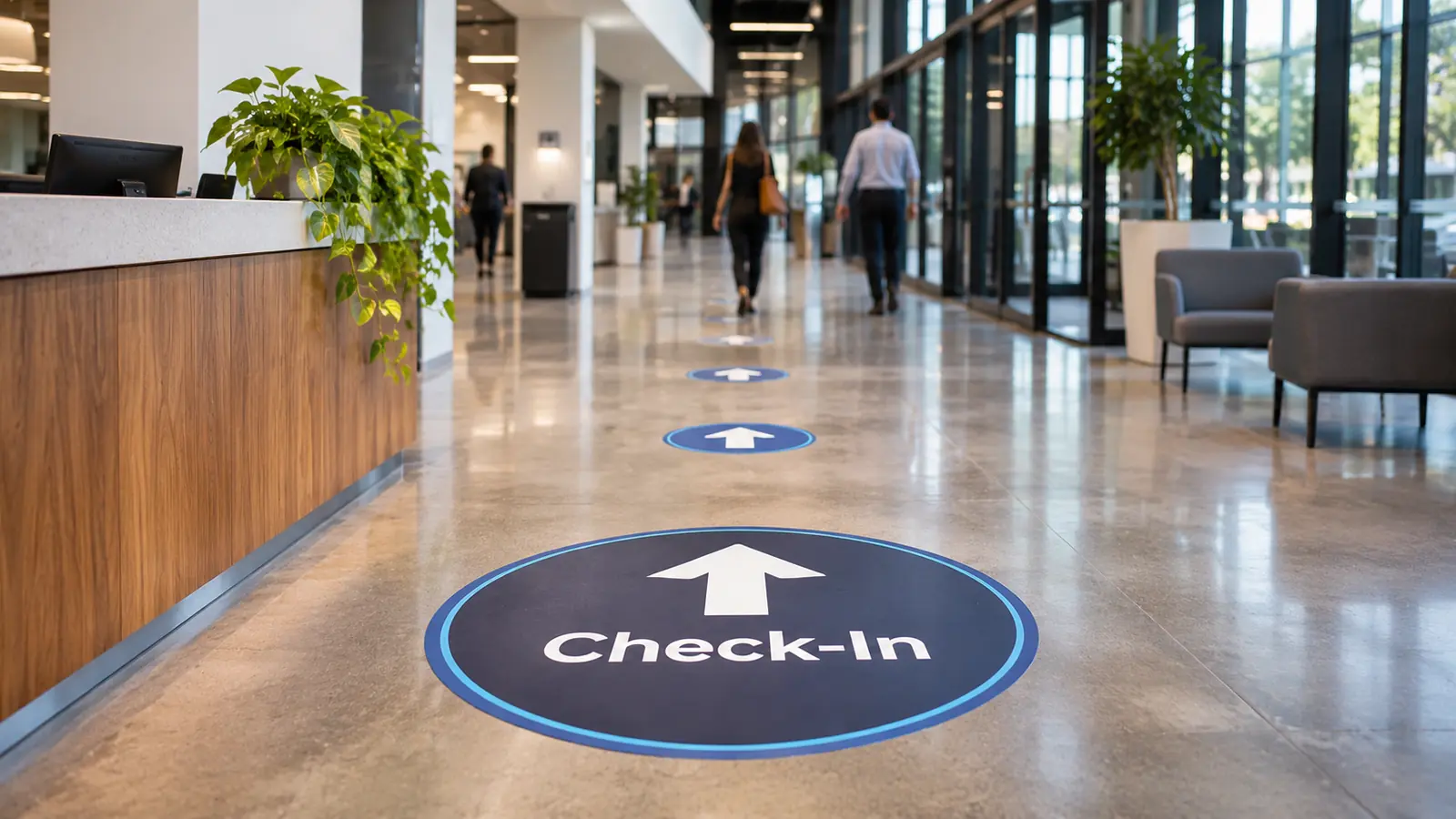
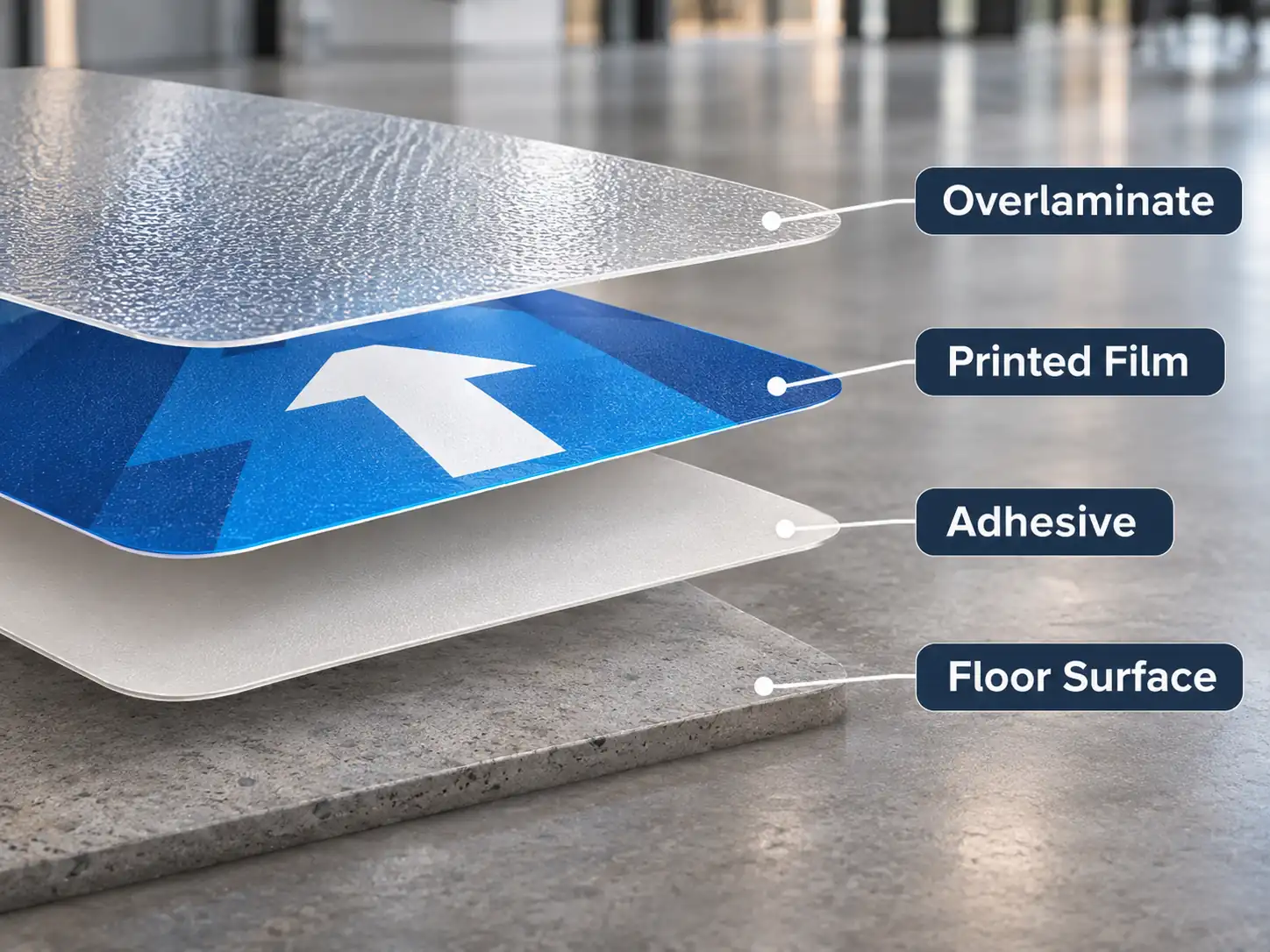
Floor graphics are printed adhesive films, often called floor decals, applied directly to a floor to show directions, promotions, branding, or safety messages. Most are a layered product: a printed vinyl or polypropylene film, a floor-rated adhesive on the back, and a textured clear laminate on top.
Businesses put them where people are already looking down or deciding where to go: entrances, checkout lines, aisle ends, waiting rooms, warehouse walkways, and trade show booths. Two jobs cover most projects. Directional graphics move people through a space. Promotional graphics put a message in front of a shopper at the moment they are choosing. Both are part of our floor graphics for directions and promotions.
What separates them from window and wall graphics is the abuse. A wall graphic gets looked at. A floor graphic gets walked on, rolled over by carts, mopped, and ground down by grit on shoe soles all day long.
Match the Material to the Floor
Most failures trace back to one mistake: using a material made for a different surface. Floor graphic media is sold by substrate, and the adhesive is the part that changes most. 3M's guidance on floor graphics notes that adhesives are formulated for specific surfaces such as wood, concrete, carpet, and tile, and that outdoor sidewalk adhesives are generally thicker so they can grip porous, textured concrete.
Smooth hard floors
Sealed concrete, VCT, luxury vinyl, ceramic tile, sealed wood, and polished stone are the easiest surfaces. A thin, removable adhesive with a slip-rated laminate works for most promotions and wayfinding. A conformable film can handle shallow grout lines and light texture. Deep grout, loose tile, and cracks are a different story, because the film cannot bond across a gap.
Commercial carpet
Carpet graphics use their own adhesive and usually a two-layer build. Low-pile commercial carpet in offices, hotels, and event halls is the realistic target. Thick or plush carpet is harder: the graphic flexes with every step and is far more likely to tear or lift. If the carpet is soft, ask whether a printed mat or a floor stand would do the job better.
Outdoor concrete and sidewalks
Exterior graphics need an aggressive adhesive, a textured film that conforms to rough concrete, and a UV-resistant laminate. Fill or avoid cracks and expansion joints. Even with the right materials, outdoor graphics wear out sooner than indoor ones, and a North Texas summer of direct sun, heat, and storms will show it.
Why the Overlaminate Matters
The clear top layer does three jobs. It protects the ink from scuffs and moisture, it stands up to cleaning, and it gives the surface the texture that keeps shoes from sliding. 3M's floor graphics article says nearly all floor graphics should have an overlaminate and identifies it as the layer that helps reduce the risk of slips.
Some one-step products print directly onto a textured, slip-rated film with no separate laminate. They cost less and go down faster, which makes them a reasonable choice for a two-week promotion. The trade-off, as 3M notes about direct-print outdoor materials, is that the image fades and wears sooner.
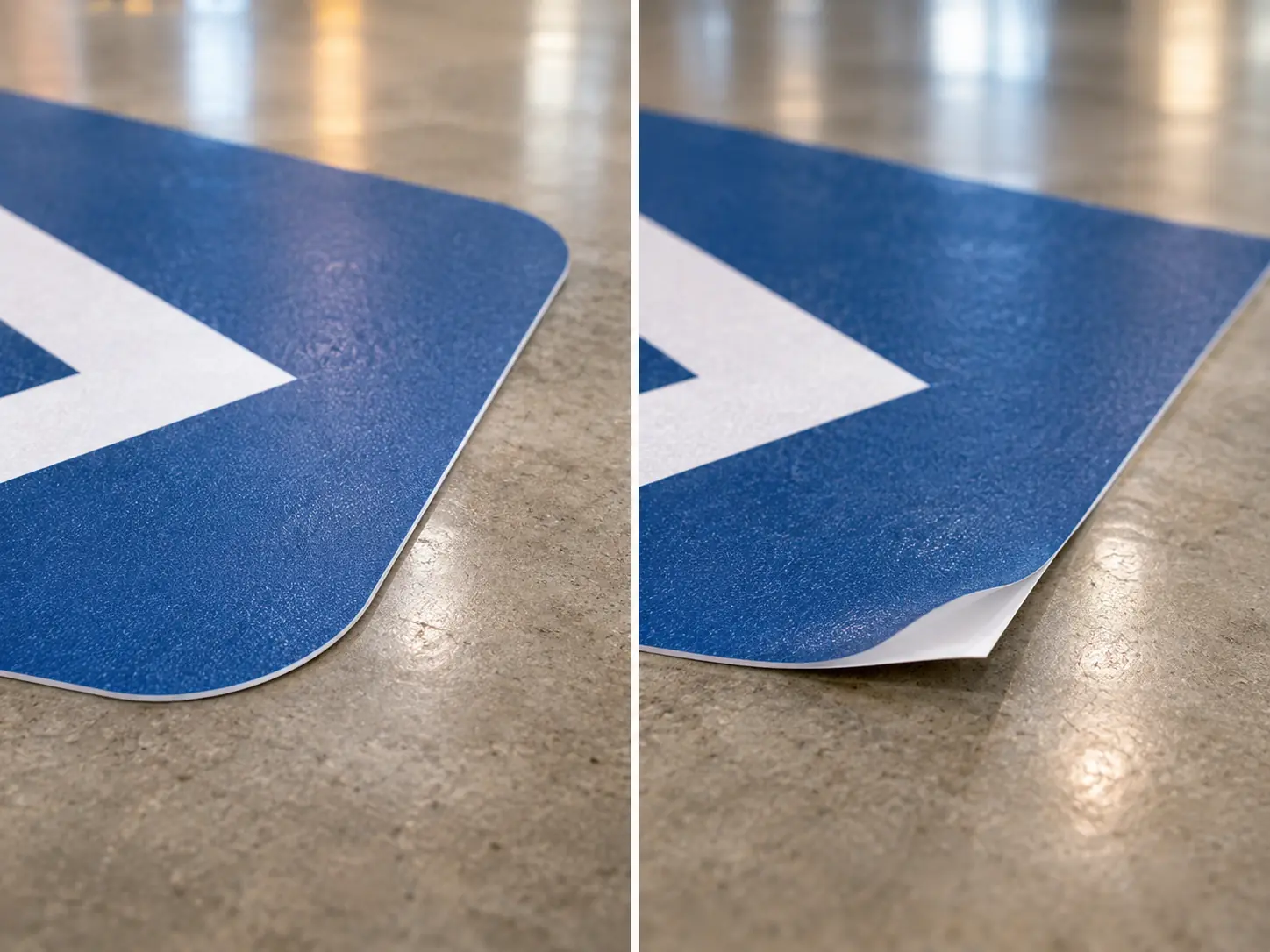
One design choice extends life at no cost: round the corners. Square corners are where edges start to lift. If your artwork has square elements, it can be printed on a clear background with rounded edges.
What "Slip Resistant" Actually Means
This is the question I would ask before approving any floor graphic, and the one most quotes skip. A spec sheet that says "slip resistant" should name the test behind the claim.
UL 410 is the long-standing U.S. standard printed on most floor graphic laminate data sheets. It measures the static coefficient of friction, which is how much force it takes to start a shoe sliding from a standstill. A 3M product bulletin for its floor and sidewalk overlaminates states that UL 410 requires an average static coefficient of friction of at least 0.50.
ANSI A326.3 measures the dynamic coefficient of friction instead, meaning traction while someone is already walking, and it is tested wet. A 2021 PRINTING United Journal article by a Mactac product manager explains that hard-surface materials for level interior floors should reach a wet DCOF of 0.42 or higher to count as high traction, and points out that UL 410 measures static rather than dynamic friction.
You do not need to become a friction expert. Ask your sign company which test the laminate passed, whether it was tested wet, and for the data sheet. At a grocery entrance, a restaurant, or anywhere the floor gets wet, that answer matters more than the print quality.
How Long Do Floor Graphics Last?
Short-term promotional floor graphics are meant to come up within weeks or a few months. Long-term indoor graphics with a quality laminate should be planned for replacement about once a year. 3M recommends thinking about annual replacement for long-term floor graphics, and warns that published film lifespans are based on testing on vertical surfaces, so real life on a floor will be lower.
What shortens the life of a floor graphic:
Placement in the first few feet inside a door, where grit and water come in.
Carts, pallet jacks, or wheelchairs turning on top of the graphic.
Floor burnishers and aggressive scrubbing pads.
Installation on a freshly waxed or dirty floor.
What extends it: a laminate chosen for the traffic level, rounded corners, a properly prepped floor, and a cleaning crew that knows the graphic is there.
Your Cleaning Crew Can Make or Break It
Talk to whoever cleans the floors before the graphic goes down. 3M's guidance says well-made floor graphics handle repeated cleaning with standard liquid and mild abrasive methods, but they should not be hit with aggressive floor pads or burnishers. If your building uses those, the crew should clean around the graphic. For long-term graphics, the better option is often to install the graphic first and apply the floor finish over it.
Timing matters too. If the floor was just waxed, wait at least 24 hours before installing. Right before application, the area should be cleaned with a mild detergent, wiped with rubbing alcohol, and dried with a lint-free towel so dust does not get trapped under the film.
Will Floor Graphics Damage the Floor When Removed?
Removable floor graphics are designed to come up cleanly from sealed floors within their rated time. The usual method is to start at a corner and peel the graphic back at roughly a 90-degree angle, using gentle heat to soften the adhesive and a scraper for any residue. The catch is that long-term adhesives grip harder, and a graphic left down well past its intended life gets harder to remove. If you lease your space, check the flooring language in the lease and plan the removal date when you order, not after.
Where Floor Graphics Work Best, and Where They Do Not
Good fits:
Checkout, pickup, and service lines, to show people where to stand.
Wayfinding in clinics, warehouses, schools, and multi-tenant buildings, paired with wall and overhead signs. Our wayfinding signage guide covers how the pieces work together.
Promotions at an aisle end or in front of a product display.
Trade show booths and event floors, where the graphic only needs to last a few days.
Branded entry graphics in lobbies and showrooms.
Poor fits:
Plush carpet, cracked tile, and uneven floors.
Ramps and stairs, unless the material is rated for that use.
Spots that stay wet much of the day, unless the laminate was tested for wet traction.
Long messages. People read a floor in a glance, so keep it to a few words or a single symbol.
Questions to Ask Before You Order Floor Graphics
Which floor surfaces will these go on, and is the adhesive made for each one?
Is there an overlaminate, and does it meet UL 410, ANSI A326.3, or both?
How long does the graphic need to last, and what is a realistic lifespan in that spot?
Who installs it, and how will the floor be prepped?
How should our cleaning crew treat it?
Will it come up cleanly when we are done?
Elevated Exposure produces and installs floor, window, and wall graphics for businesses across Dallas Fort Worth. If you have a space in mind, send a few photos of the floor and the traffic area with your free estimate request.
Frequently Asked Questions
How long do floor graphics last?
Short-term promotional floor graphics last from a few weeks to a few months. Long-term indoor graphics with a quality overlaminate should be planned for roughly annual replacement, and outdoor graphics wear faster. Foot traffic, cleaning methods, and floor prep make the biggest difference.
Are floor graphics slippery?
Not when they are made correctly. Commercial floor graphics use a textured overlaminate tested for slip resistance, most often to UL 410 or ANSI A326.3. Ask which test the laminate meets and whether it was tested on a wet surface.
Can floor graphics go on carpet?
Yes, on low-pile commercial carpet with a carpet-specific adhesive. Thick or plush carpet flexes too much underfoot, so graphics there tend to tear and lift early.
Can you put floor graphics outside?
Yes, with films and adhesives made for rough concrete and a UV-resistant laminate. Outdoor graphics do not last as long as indoor ones, and they should not cross cracks or expansion joints.
Do floor graphics damage floors?
Removable graphics are designed to peel off sealed floors cleanly within their rated time. Long-term adhesives can leave residue that takes heat and a scraper to clear, so match the adhesive to how long you actually need the graphic.
How much do floor graphics cost?
It depends on size, quantity, the material build (one-step or laminated), the floor surface, and whether installation is included. A batch of identical wayfinding decals costs much less per piece than a single custom floor mural, so it helps to plan a full set at once.
Sources
3M Commercial Solutions, "Doing Floor Graphics Right," August 2020.
Amanda Smith (Mactac), "Are Your Floor Graphics Compliant?" PRINTING United Journal, March 2021.
3M Scotchcal Overlaminates 3645 and 3647 product bulletin (UL 410 slip resistance values).
UL Solutions, UL 410 Standard for Slip Resistance of Floor Surface Materials.