


Step and Repeat Backdrop Sizes & Setup Tips for DFW Events
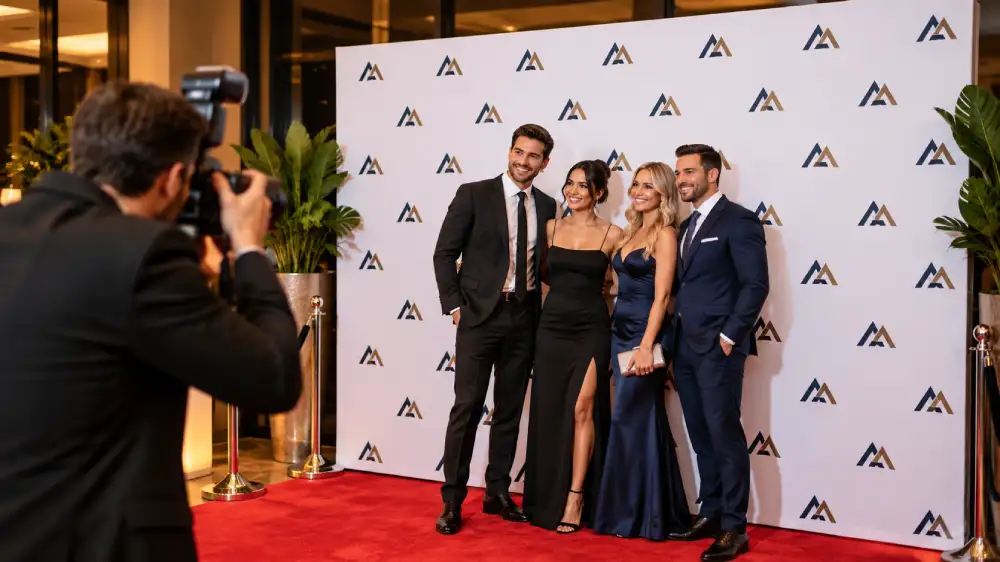
Most step and repeat backdrops fail at the same moment: when a guest holds up a phone. The backdrop looked great when it came out of the box, then every photo from the night cuts the logo in half or buries it behind a row of shoulders.
The fix is to plan the backdrop from the camera's point of view. For most DFW events that means an 8 x 8 foot backdrop for individuals and couples, 10 x 8 feet or wider for groups, matte fabric instead of glossy vinyl, and a logo pattern sized so at least one full logo lands beside every face in a vertical phone photo. The rest of this guide covers how to get each of those right, plus where to place the wall on event day so people actually use it.
Key takeaways
✓ Size the backdrop by how many people will stand in front of it at once, not by the size of the room. 8 x 8 feet covers one to four people.
✓ Choose matte fabric for any event with flash photography or bright stage lighting. Glossy vinyl throws hot spots into photos.
✓ Put the densest logo repetition between roughly 4 and 7 feet off the floor, where phone photos actually crop.
✓ Leave 6 to 10 feet of open floor in front of the wall for guests and the photographer.
✓ Lock your sponsor list and vector logos at least two weeks before the event. Approvals take longer than printing.
What Is a Step and Repeat Backdrop?
A step and repeat backdrop is a printed wall covered in a repeating pattern of logos, set up as the background for event photos so every picture carries the brand. The name comes from red carpet events, where guests step forward, pose, and repeat the process every few feet.
It is a different job from a trade show back wall. A booth backdrop has to sell from across an aisle, so it carries a headline, product images and a short message. A step and repeat has one job: make the logo readable in photos taken from 6 to 10 feet away. If you need a booth back wall, our event signage page covers those layouts. If you are planning a photo wall for a gala, grand opening, awards night, sports banquet or press event, keep reading, and see our step and repeat backdrops service for production options.
Step and Repeat Backdrop Sizes: Pick by Group Size, Not Room Size
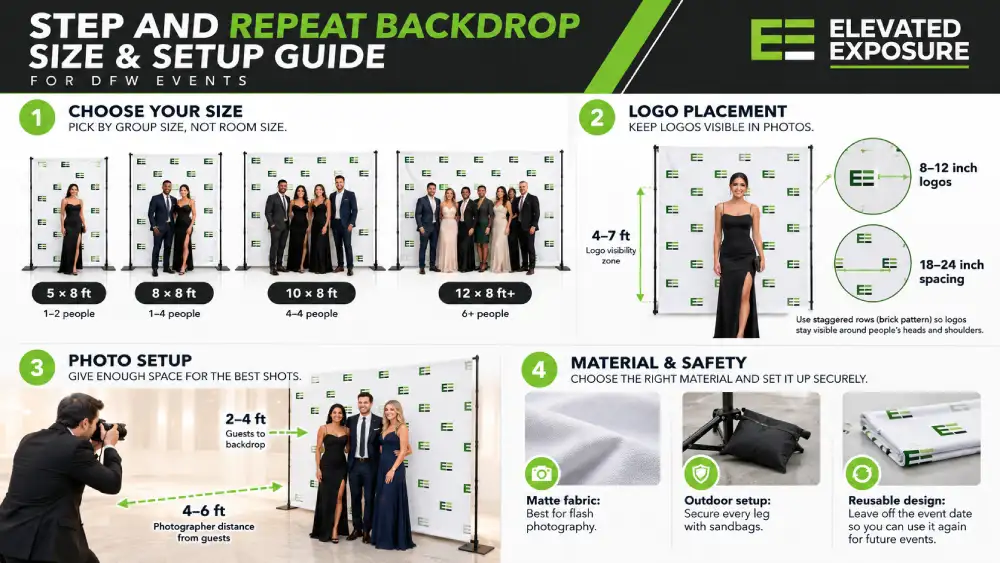
Sizes are listed width x height. Height is almost always 8 feet, because that clears tall guests, heels and raised arms with room to spare. Width is the decision that matters, and it depends on how many people will pose together.
Backdrop size (W x H) | Best for | People in frame |
|---|---|---|
5 x 8 ft | Check-in areas, hallways, small private dining rooms | 1 to 2 |
8 x 8 ft | Most corporate events, grand openings, holiday parties | 1 to 4 |
10 x 8 ft | Awards nights, sports banquets, nonprofit galas | 4 to 6 |
12 x 8 ft and wider | Team photos, title sponsor walls, multi-camera press lines | 6 or more |
A simple test we use with clients: count the largest group you expect in one photo, give each person about 2 feet of width, then add 2 feet on each side. Without that margin, the photographer's wide shot catches the edge of the frame, a wall outlet or a stack of chairs. A team of six needs 12 feet of shoulders plus 4 feet of margin, so a 16 foot wall, or two 8 foot units placed side by side with the pattern lined up across the seam.
Check the ceiling before you order. Hotel ballrooms and convention halls in Dallas and Fort Worth handle an 8 foot wall easily, but restaurant private rooms, older office lobbies and some event venues with soffits or hanging fixtures do not. Measure the lowest point near where the wall will stand.
Fabric vs. Vinyl: Why Most Photo Walls End Up Matte
Fabric (dye sublimated polyester)
Fabric is the default for photo walls. The ink is bonded into the fibers, so the surface is matte and flash bounces off it evenly instead of creating a white hot spot behind someone's head. It also folds into a bag, comes back flat on a tension frame, and can be washed after a messy event. If you plan to use the backdrop more than once, fabric is almost always the better buy.
Vinyl
Vinyl costs less for a one time event and takes grommets, so it can be zip tied to a fence or pipe and drape. The tradeoff is reflection. Standard glossy vinyl photographs poorly under flash or stage lights, so if you go with vinyl, ask for a matte finish. Vinyl also creases where it is folded, so store it rolled on a tube.
Mesh vinyl for outdoor events
Mesh lets wind pass through, which matters at outdoor events in North Texas. The catch is that light and background details show through the holes, so photos look busier. Mesh works for a fence banner. It is a compromise for a photo wall.
Designing the Logo Pattern for Phone Photos
This is where most backdrops go wrong, and it is the part most guides skip. Nearly every photo taken at your event will be a vertical phone shot, cropped from about the waist to a foot above the tallest head. Design for that crop.
Put the logos where the camera looks
Logos below about 3 feet are hidden by bodies. Logos above about 7.5 feet get cropped out of most phone photos. The zone between roughly 4 and 7 feet is where your brand actually shows up, so that band should have the tightest repetition. The bottom and top can carry the pattern more loosely, or a solid band of color.
Size and spacing
A logo should be large enough to read in a phone photo from 6 to 8 feet away and small enough that one full logo fits in the gap between two people. In practice that usually means logos in the 8 to 12 inch range, repeated every 18 to 24 inches. Very wide wordmarks need more room than a square icon, so test your own logo instead of applying one number to every brand.
Stagger the rows
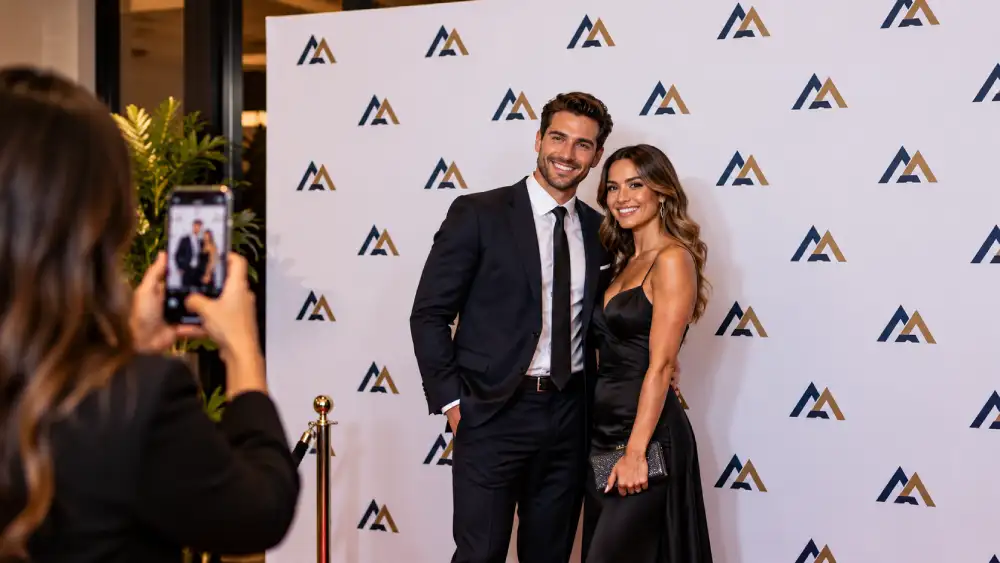
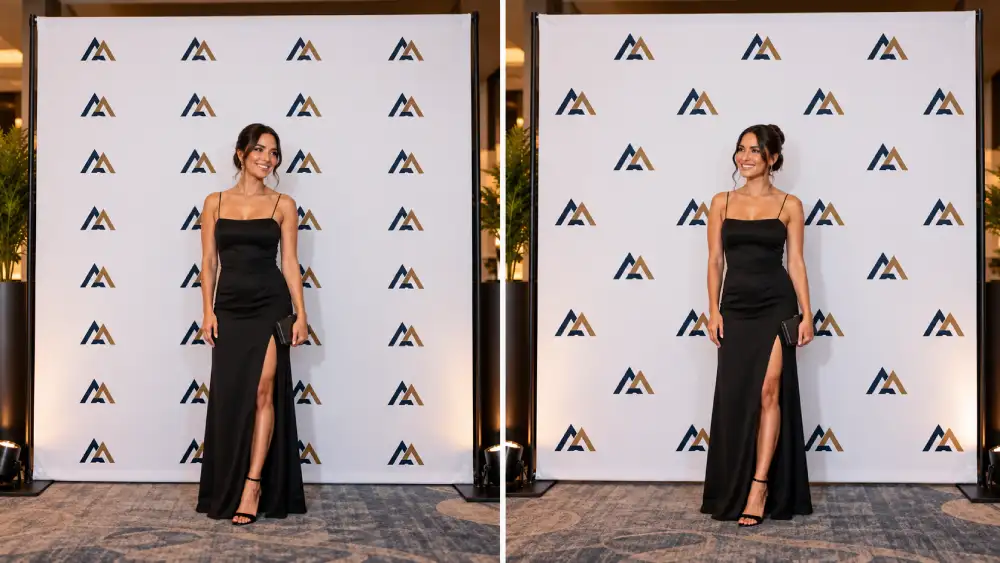
Offset each row by half a step, like a brick wall. With a straight grid, a person can line up with an entire column and erase it. With a staggered pattern, a logo almost always peeks out on both sides of every guest.
Sponsor walls
When the backdrop carries the host plus sponsors, alternate the host logo with sponsor logos and give the title sponsor more repeats rather than a bigger logo. Mixed logo sizes break the rhythm of the pattern and look messy in photos. More than three or four different marks starts to read as noise, so consider a separate sponsor board for the long list.
Background color
Pure white blows out under flash and makes skin tones look washed. Pure black swallows dark suits and dresses, so guests look like floating heads. A mid tone or a muted version of your brand color usually photographs best. Whatever you choose, keep strong contrast between the logo and the background.
File setup
Send vector logos (AI, EPS, SVG or a vector PDF) so they print sharp at full size. Keep logos and text at least 4 inches from the top and bottom edges, because pole pockets and frame edges wrap that part of the graphic. If your brand guide calls for exact colors, include the Pantone references.
Stands and Frames: What Holds Up Over Several Events
The frame decides how the backdrop looks in photos as much as the print does.
Adjustable telescoping stands are the lightest and least expensive option. The graphic slides onto top and bottom poles through pole pockets. They work well for one or two events a year, though fabric on a pole stand can show slight waves.
Tension fabric frames use aluminum tubes with a pillowcase style graphic pulled over them. They take a few extra minutes to assemble and produce the smoothest, wrinkle free surface, which is why they look best on camera.
Pop up accordion frames expand in one motion and attach the graphic with magnetic or hook bars. Setup is fast, though the case is heavier to carry.
Whatever the frame, plan for weight. A backdrop near a busy entrance or a bar line will get bumped, so add sandbags or weighted feet on the base. If you are also bringing banner stands, our retractable banner stand buyer's guide covers what separates hardware that lasts from hardware that doesn't.
Where to Put the Backdrop on Event Day
A well designed wall in the wrong spot gets ignored. Placement decides whether people stop.
Follow the guest flow
The best spot is usually just past check-in, where guests have their name badge, have not yet found a drink, and still want a photo. Keep the wall out of doorways and fire exits, and leave room for a short line to form without blocking the main path. Venues and the fire marshal will expect clear egress.
Leave room in front
Give guests 2 to 4 feet between their backs and the wall so they do not cast shadows on it, plus another 4 to 6 feet for the photographer. A floor decal or a short runner marking where to stand helps more than you would expect, especially when there is no hired photographer directing people.
Watch the light
Ballroom uplighting in purple or blue tints faces and logos. If the room is dim or color washed, a single LED panel or ring light aimed at the wall area fixes most problems. Avoid putting the backdrop under a single bright spotlight, which creates harsh shadows under eyes and a hot spot on the fabric.
Outdoor events in DFW
Wind is the real problem outside. North Texas afternoons can turn gusty, especially in spring, and a fabric backdrop acts like a sail. Weigh down every leg with sandbags, consider a smaller wall, and keep an eye on it the whole time. Direct afternoon sun also fades the photo quality, so set up in shade or face the wall away from the low sun when you can.
Timeline and What to Send Your Sign Shop
Printing a step and repeat is fast once the artwork is final. The slow part is almost always approvals, especially when sponsors need to sign off on logo placement. Give yourself at least two weeks before the event when sponsors are involved.
To get an accurate quote and a clean first proof, send:
The event date, venue, and whether the wall is indoors or outdoors.
The size you want, or the largest group you expect in one photo.
Vector logos for the host and every sponsor, plus any brand color references.
The sponsor list with tiers, if some get more repeats than others.
Whether you need a new frame or a graphic only for a frame you already own.
Delivery, pickup and setup needs.
Rent, Buy, or Reprint the Graphic Only?
If your business hosts two or more events a year with the same branding, buying usually makes sense. A fabric graphic on a tension frame can last for many events with basic care.
One tip that saves money: leave the date and event name off the backdrop. A wall that only carries your logo can be reused for your holiday party, your grand opening and next year's open house. When the sponsor mix changes every year, keep the frame and order a new graphic only, which costs much less than a full kit.
Frequently Asked Questions
How far should people stand from a step and repeat?
Guests should stand about 2 to 4 feet in front of the backdrop. That keeps their shadows off the wall and lets the camera focus on faces while the logos stay readable. The photographer usually works another 4 to 6 feet back.
How many logos should be on a step and repeat?
Most backdrops look best with one to four different logos. Repeat the host logo across the whole wall and alternate it with sponsor logos, giving top sponsors more repeats. Beyond four marks, the pattern starts to look cluttered in photos.
Can you use a step and repeat outdoors in Texas?
Yes, but plan for wind. Use heavy sandbags on every leg, consider mesh vinyl or a smaller wall, and avoid placing it in direct afternoon sun. A fabric backdrop on a tension frame is best kept to covered or indoor areas.
How much does a step and repeat backdrop cost?
Cost depends on size, material, the type of frame, and whether you need a new frame or only a new graphic. A graphic only reprint for a frame you already own costs much less than a complete kit. The fastest way to get a real number is to request a quote with your size and logos.
How long does it take to make a step and repeat backdrop?
Production itself takes only a few days once the artwork is approved. Design and sponsor approvals usually take longer, so start at least two weeks before your event when several logos are involved.
What is the difference between a step and repeat and a banner stand?
A step and repeat is a large photo wall with a repeating logo pattern, built to appear behind people in photos. A retractable banner stand is a narrow, single message display meant to be read by people walking past. Many events use both.
Planning a Photo Wall for Your Next Event?
A step and repeat earns its cost after the event, in every photo guests post and every press shot that carries your logo. Getting the size, material and pattern right is what makes that happen.
Elevated Exposure Signs and Graphics designs and produces step and repeat backdrops for events across Dallas, Fort Worth and the surrounding cities, along with matching table covers and booth displays. Send us your logos and event date through our free estimate form and we will help you pick the right size and layout.