



Restaurant Signage Ideas That Attract More Customers in Dallas-Fort Worth
Key takeaways
Good signage for a restaurant works in layers: a lit sign drivers can read from the road, a smaller sign for people on the sidewalk, and interior signs that carry guests from the door to the table.
In DFW, the ideas that get built are the ones your landlord and city approve, so check sign criteria and permit rules before you commit to a design.
Start outside. A 2012 FedEx Office survey found that 76 percent of American consumers had entered a store they had never visited based on its signs.
Keep the message short: your name, your cuisine, and one line at most.
If you are shopping for signage for a restaurant, start from one fact: diners decide from the car. They catch a name, a glow, and a general feeling, and they choose whether to slow down. The restaurant signage ideas below follow that moment, from the sign that stops a driver on a busy DFW corridor to the small panels that guide a guest from the host stand to a table.
Most lists of restaurant sign ideas come from online sign shops and national chains. They show attractive examples and skip the parts that decide whether a sign ever goes up in Dallas or Fort Worth: landlord approval, permits, and electrical work. This guide keeps those parts in. If you already know you need a sign designed, built, and installed, our restaurant and hospitality signage in Dallas and Fort Worth page explains how that works.
Why Signage for a Restaurant Does So Much Work
A restaurant sells something people cannot sample from the street. The sign is the only part of the experience they get before they commit, which is why it carries more weight here than it would for an accounting office.
The data supports that, with a caveat about age. A 2012 FedEx Office survey of American consumers found that 76 percent had entered a store they had never visited before based on its signs, and 68 percent had bought a product or service because a sign caught their eye. The same survey found that 52 percent were less willing to enter a store with misspelled or poorly made signs. It is a 2012 study, so read the percentages as a direction, not a forecast. The direction still holds: a tired or sloppy sign costs you walk-ins.
Timing matters too. A lot of dinner trade happens after dark for a good part of the year, so your sign has to do its job when the sun is down and the road is busy.
Exterior Restaurant Signage Ideas
Start outside. These ideas do the most work, listed roughly in order of how far away they can be seen.
1. Illuminated channel letters for your main identity
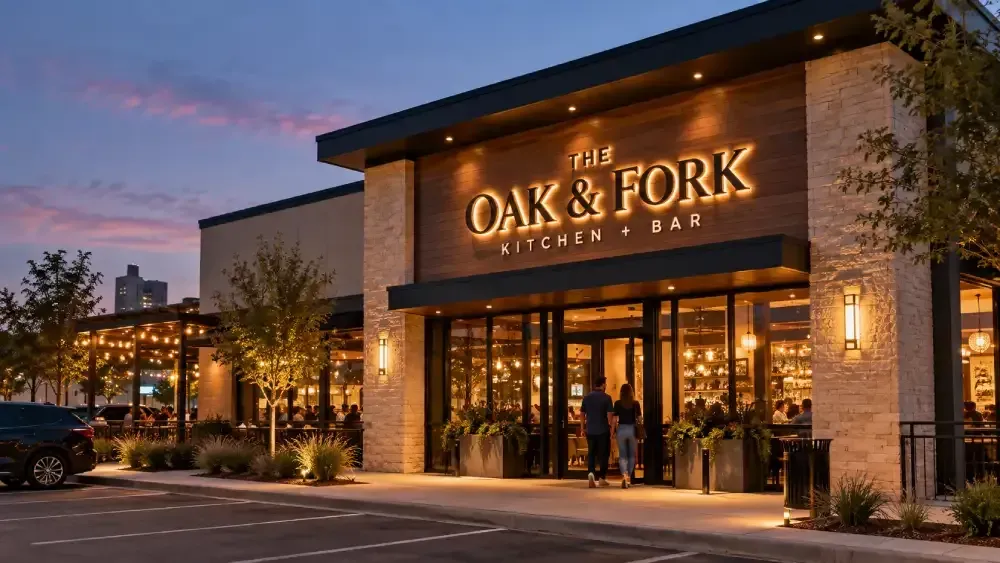
Channel letters are individually fabricated letters, usually lit from inside with LEDs. For a restaurant they are the standard answer to the question of what a night sign should look like. Front-lit letters read clearly from a distance. Halo-lit letters, which glow around the edge and cast soft light on the wall behind them, suit a dinner-focused, sit-down concept. If your storefront has a flat fascia, this is usually the first sign to plan around. Our channel letter signs page shows the options and how they are built.
2. A blade sign for walkable streets
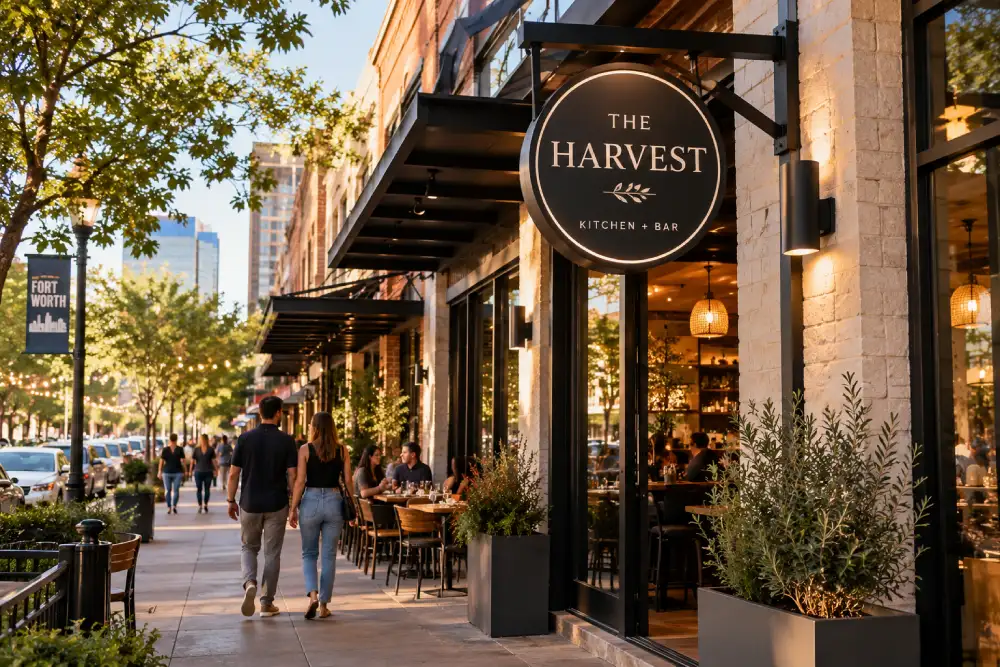
A blade sign (also called a projecting sign) mounts at a right angle to the building, so someone walking down the sidewalk sees it before they reach your door. It is the best fix for a restaurant in a walkable district or in a row of storefronts where a flat wall sign is invisible until you are standing in front of it. Not every city or landlord allows them, and projection limits vary, so clear this idea early.
3. A tenant panel on the monument or pylon
If your restaurant sits in a strip center or shopping center, the first sign a driver sees is probably not on your building. It is your panel on the shared sign near the road. Size, layout, and sometimes typeface are set by the landlord, so the job is to make your panel as readable as the rules allow: high contrast, your name in the largest letters the panel permits, and one cuisine word so drivers know what you serve. Our monument sign page covers how these shared structures work.
4. A sidewalk A-frame for today's special
Sidewalk signs are the cheapest way to change your message daily: lunch specials, happy hour, a new patio menu. Check local rules for where they can stand, since public walkways and shared centers often restrict them. Keep the wording to a few words a person can read while walking.
5. Window graphics with hours and cuisine
Window graphics do three useful things: they state your hours, they name your cuisine, and they let people see in. Perforated vinyl lets guests inside see out while the graphic shows on the street side. Put your hours on the glass, because hours answer the first question a walk-up guest has.
6. Banners and patio signs for openings and seasons
Temporary banners suit grand openings, seasonal menus, and event nights. In Texas sun, inexpensive vinyl fades quickly, so ask about materials rated for UV exposure and plan to replace banners instead of leaving them up for years. A tired banner says the opposite of what you want guests to think.
Interior Restaurant Signage Ideas
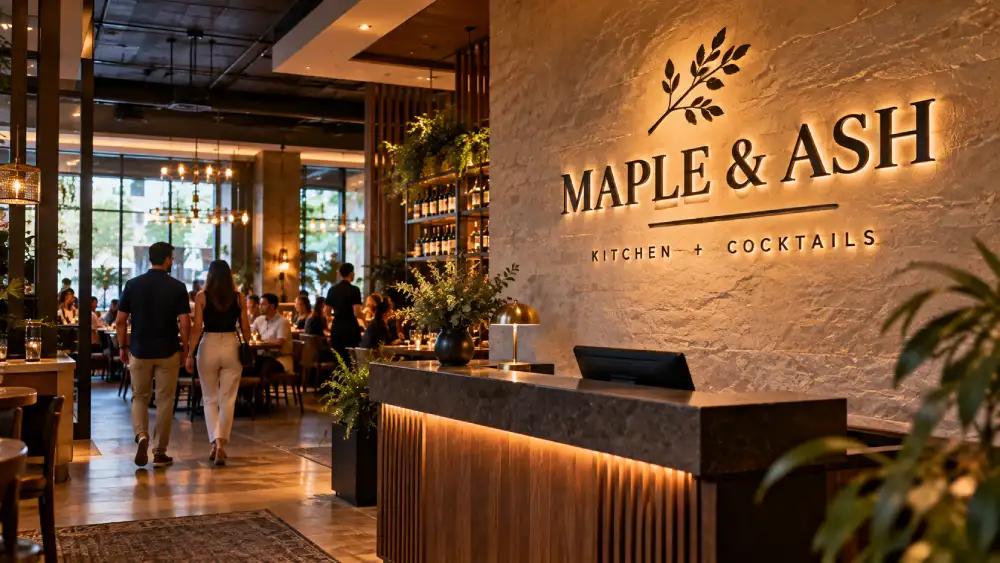
Once guests are through the door, signs stop attracting and start guiding. Good interior signage makes the room feel organized before anyone has said a word to a server.
7. A dimensional logo wall
Behind the host stand or at the end of the entry hall, a dimensional logo (cut-out letters or an acrylic logo mounted off the wall) anchors the brand and often becomes the backdrop for guest photos. It also gives the room a focal point that paint alone does not.
8. Menu boards that match how often your menu changes
Digital menu boards let you change prices and swap breakfast for lunch on a schedule, but they cost more up front and depend on reliable screens and someone keeping the content current. A printed or changeable letter board is fine for a short menu that rarely changes. Choose the method based on how often you actually edit your menu, not on what looks modern.
9. Wayfinding and required signs
Restroom signs, exit paths, a pickup shelf label, and a floor graphic that shows where to wait in the takeout line are not glamorous, but they decide how smooth the room feels on a busy Friday. Permanent room signs such as restrooms generally fall under ADA signage requirements, so specify them correctly the first time instead of replacing them after an inspection.
Design Choices That Make Any Sign Work Harder
The best idea on this list fails if the design is hard to read. A few choices matter more than the rest.
Contrast comes first. Light letters on a dark background, or the reverse, will beat a clever color scheme every time. Test your design by squinting at it from across a parking lot, or by shrinking it on a screen until it is thumbnail size. If the name is still readable, it passes.
Say less. Drivers get a second or two. A name, a cuisine word, and perhaps a short line is the limit. Hours, the full menu, and a list of awards belong on the window or inside.
Think about lighting. A sign that looks sharp at noon can wash out or glare at night. If you serve dinner, design for the lit version first, and confirm how the colors will look once the lights are on.
Color is a supporting actor. Red, yellow, and orange are common in food branding, but a muted palette can suit an upscale concept just as well. Pick colors that match your brand, then make sure the contrast holds.
What to Check in DFW Before You Order a Restaurant Sign
This is the part most idea lists leave out, and it is where projects in Dallas and Fort Worth stall.
Read your lease and the landlord's sign criteria first. Shopping centers and multi-tenant buildings often set rules for sign size, placement, lighting, and style. A design that ignores them will be sent back, and the delay comes out of your opening date.
Confirm permit requirements for your city. Most illuminated exterior signs need review before installation, and requirements differ between cities. Our Dallas sign permit guide and Fort Worth sign permit guide walk through what to expect in each.
Ask who does the electrical work. Illuminated signs need electrical connections. At Elevated Exposure, electrical installation on illuminated signs is performed by licensed Texas electrical sign contractors, and it is a fair question to put to any sign company you are considering.
Plan for lead time. Fabricated and illuminated signs take longer than vinyl graphics, and permit review adds to it. If you are opening a new location, start the sign early, since it is often one of the last items to arrive.
A sensible order of operations: get the landlord's sign criteria, confirm the city's permit rules, settle the design, then fabricate and install. Working in that order avoids the most expensive mistake in restaurant signage, which is paying for a finished sign that cannot go up where you planned.
Choose materials for the heat. North Texas summers are hard on cheap vinyl and thin plastics. Durable materials and finishes cost more on day one and less over a few years, and a faded sign reads as a neglected restaurant even when the kitchen is excellent.
Which Sign Ideas Fit Which Type of Restaurant
Every concept has a different first priority. Use this table to decide where to spend first.
Restaurant type | Lead with | Add next |
Sit-down dinner | Halo-lit or front-lit channel letters | Dimensional logo wall, blade sign |
Quick service or takeout | High-contrast lit sign, tenant panel on the pylon | Window graphics with hours, floor graphics for the pickup line |
Cafe or bakery | Blade sign and window graphics | A-frame for daily specials, changeable menu board |
Bar, grill, or patio concept | Lit sign with a strong name treatment | Patio signage, banners for event nights |
Tenant in a strip center | Tenant panel on the shared monument | Storefront sign within landlord criteria, window graphics |
Frequently Asked Questions About Restaurant Signage
What is the best signage for a restaurant?
An illuminated exterior sign that shows your name and cuisine is the best starting point, backed by window graphics with your hours and a clear interior menu. Which exterior sign fits depends on your building: channel letters on a flat storefront, a tenant panel in a shopping center, or a blade sign on a walkable street.
How do I attract customers to my restaurant with signs?
Make the sign readable from where people approach, whether that is a car or a sidewalk. Use high contrast, a short message, and lighting for evening visibility. Then add small signs that answer questions quickly, such as hours on the window and a special on an A-frame.
How much does restaurant signage cost?
It depends on sign type, size, lighting, and installation, so a single number would mislead you. A window graphic and a set of illuminated channel letters are very different projects. Our commercial sign cost guide explains what drives pricing in Dallas-Fort Worth.
Do I need a permit for a restaurant sign in Dallas or Fort Worth?
Most illuminated exterior signs need review before installation, and requirements vary by city. Check with the city and get your landlord's approval first. Our permit guides for Dallas and Fort Worth list what to prepare.
What colors work best for a restaurant sign?
Contrast matters more than any single color. Red, yellow, and orange are common in food branding, but a dark background with light letters, or the reverse, will read well in almost any palette. Choose colors that fit your brand, then check them at night.
Planning Your Restaurant Signs
The strongest restaurant signage plans start with the exterior, add a few well-chosen small signs, and get landlord and permit questions answered before design is final. If you would like a second opinion on what would work for your storefront, our team can help. See our exterior building signage options, or start from our restaurant and hospitality signage page and request a free estimate.
Related reading: How Much Do Commercial Signs Cost in Dallas Fort Worth, Do You Need a Permit for a Business Sign in Dallas or Fort Worth, and 5 Types of Business Signs That Attract More Customers.