


Sign Refacing vs. Full Replacement: How to Update Your Business Signs After a Rebrand
A new logo is the easy part of a rebrand. The hard part shows up a few weeks later, when someone has to decide what happens to the monument sign by the road, the letters on the building and the panel on the shopping center pylon.
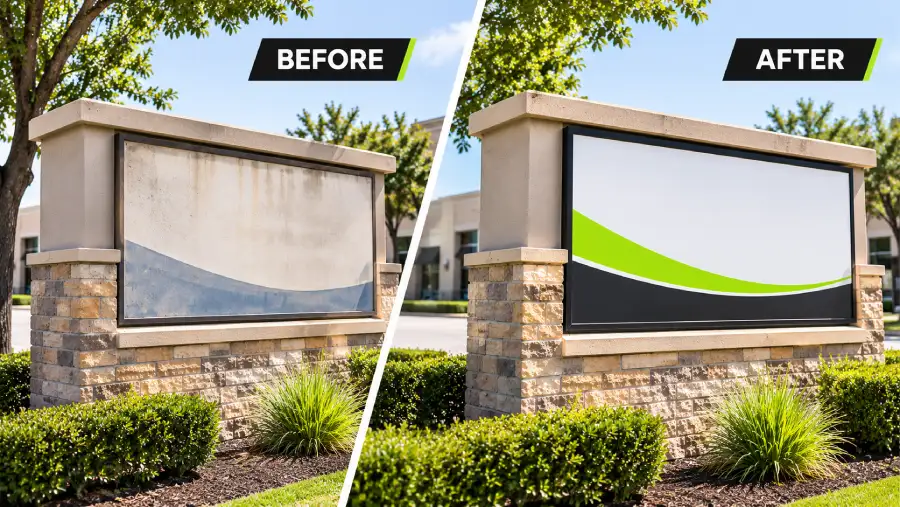
Sign refacing means replacing the face of an existing sign (the printed or routed panel, or the faces of channel letters) while keeping the cabinet, structure, wiring and foundation that are already in place. If the structure is sound, the lighting works and the new logo fits the same shape, a reface is usually faster and cheaper than a new sign. If the structure is failing, the electrical is worn out or the new brand needs a different size or shape, full replacement is the better call. This guide walks through how to tell which one you have.
Key takeaways
A reface swaps the sign face and keeps the structure. Replacement builds a new sign from the ground up.
Reface when the cabinet, poles and foundation are sound, the lighting can be repaired or upgraded, and the new logo fits the existing shape.
Replace when there is rust, cracks or water damage, repeated electrical failures, or the new brand needs a different size or sign type.
An old sign that no longer meets current code may be protected as it stands. Replacing the structure can mean losing that size.
A reface is not automatically permit-free. Some DFW cities, including Irving, require a permit even for sign repairs.
Plan the whole rebrand in order: exterior first, then lobby, ADA and vinyl, so customers never see two brands at once.
In this guide
What sign refacing includes
Reface or replace: a quick decision table
When refacing works
When you need a full replacement
The grandfathered sign question
Permits and landlord approval for refaces in DFW
Upgrading old lighting during a reface
Monument and pylon tenant panels
A rebrand checklist for every sign you own
Frequently asked questions
What Sign Refacing Includes
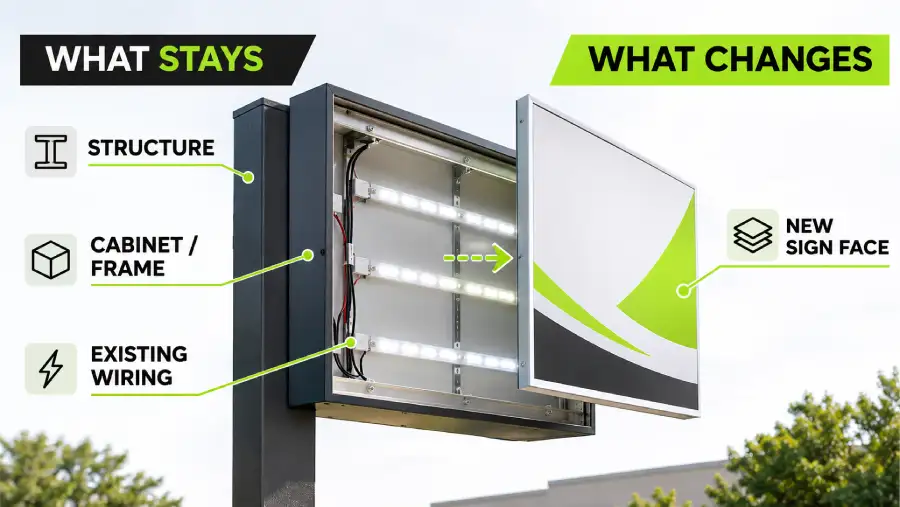
Most commercial signs have two parts that age at different speeds. The structure (the cabinet, poles, masonry base, raceway and footing) is built to last decades. The face (the part with your name and logo on it) takes the sun, weather and brand changes, and it is designed to come out.
A reface replaces only that face. Depending on the sign, it can mean:
Cabinet or lightbox signs: a new acrylic or polycarbonate face, or a printed flexible face stretched in the frame.
Monument signs: new routed aluminum panels, dimensional letters or printed inserts set into the existing base.
Pylon and multi-tenant signs: one or more tenant panels swapped while the rest of the sign stays as it is.
Channel letters: new acrylic faces and trim cap on existing letter returns, when the new name uses the same letter shapes. A new name almost always means new letters.
What stays: the foundation, the structure, the cabinet frame and, if it is in good shape, the electrical. That is where the savings come from. You are not paying again for engineering, footings, a crane or a new electrical run.
Reface or Replace: A Quick Decision Table
Walk around your sign with this table. If most of your answers land in the "Points to a reface" column, a reface is likely the right move.
Question | Points to a reface | Points to replacement |
|---|---|---|
Is the cabinet, pole or base sound? | No rust-through, cracks or leaning | Rust, cracked masonry, water inside the cabinet, movement in the footing |
How is the lighting? | Works, or can be retrofitted to LED in the same cabinet | Repeated failures, burned wiring, parts no longer available |
Does the new logo fit the existing shape? | Same proportions, fits the face area | Different shape, needs more height or width, or a different sign type |
Is the sign protected as an older, nonconforming sign? | Yes, and a reface keeps it as is | No, or you want a size or type the old sign never had |
How long will you stay at this location? | Short or uncertain lease | Long-term or owned property |
How fast do you need it? | Before a launch date | Time for design, engineering and permits |
When Refacing Works
Refacing makes the most sense when the problem is the message, not the sign. A faded face, a new logo in the same shape, a name change that keeps the same panel, or a new tenant moving into a space with an existing cabinet are all classic reface jobs.
It is also the smart option when time is short. A reface skips the parts of a new sign project that take the longest: structural engineering, foundation work and, in many cases, the full review a new structure goes through. If your rebrand has a fixed launch date, refacing the road sign and the storefront can be the difference between opening with the new name and opening behind a temporary banner.
Printed vinyl faces on older cabinets tend to be the first to fade under Texas sun, usually on the side that faces south or west. If that is why you are refacing, ask about a sturdier face material. It costs a little more up front and holds its color longer, so you are not back on a lift in a few years.
When You Need a Full Replacement
A new face on a failing structure is money spent twice. These are the signs that a reface will not hold up:
Rust or corrosion on the cabinet, poles or fasteners, especially at the base where water collects.
Water inside the cabinet or stains on the face, which usually means failed seals and wiring at risk.
Cracked or shifting masonry on a monument sign, or a pole sign that leans.
Electrical problems that keep coming back, like sections that go dark, flicker or trip a breaker.
A new brand that does not fit, such as a horizontal logo going into a tall narrow cabinet, or a move from a lightbox to individual channel letters.
The last point catches a lot of businesses mid-rebrand. A logo redesigned for screens and social media often has a different shape than the old one. Squeezing it into the old cabinet usually means shrinking it, and a smaller logo on the same sign reads from a shorter distance. Before you commit, check how big the new logo will actually be on the face. Our guide to sign letter height and viewing distance shows how to run that number.
The Grandfathered Sign Question
This is the part most reface articles skip, and it can be the most expensive mistake in the whole project.
Sign codes change. A pylon or monument that was legal when it went up 20 years ago may be taller or larger than what the city allows today. Signs like that are usually called nonconforming, or grandfathered: they can stay as they are, but they do not meet current rules. The catch is that tearing one down and replacing it can mean the new sign has to meet today's code, which may mean a smaller or shorter sign than the one you have.
Refacing is often the way to keep that size. But it is not always a like-for-like swap. In Fort Worth, for example, nonconforming signs carry their own size and height limits, so a new face on an older cabinet still needs to be checked, as we explain on our Fort Worth sign company page. Before you approve a teardown, ask your sign company whether the existing sign is nonconforming and what you would lose by replacing it. That one question can decide the whole project.
It is also why we read the sign ordinance before we quote a reface or a replacement. My background is in city and regional planning, and our team treats a sign's code status as part of the estimate, not something to discover at permit review.
Permits and Landlord Approval for Refaces in DFW
A common assumption is that a reface never needs a permit because nothing structural changes. In DFW, that depends on the city and on what the job actually involves.
Irving is the clearest example. Its sign ordinance requires a permit before an outdoor sign is erected or repaired, and repairs are included, so reskinning an existing cabinet sign is not automatically exempt. We break down how that works on our Irving sign company page. Other cities draw the line differently, often based on whether the structure, size or electrical changes. Changing lighting usually brings in an electrical permit, and under Texas law that work has to be done by a licensed electrical sign contractor. For the general rules, see our post on whether you need a permit for a business sign.
If you lease, the landlord comes first. Most shopping center and office leases require written approval for any sign change, including a new face on the same cabinet, and many centers have sign criteria that set colors, materials and lighting. A rebrand is a good moment to read yours again. Our post on multi-tenant signage standards explains what those documents usually cover.
Upgrading Old Lighting During a Reface
A reface is the cheapest moment to fix the lighting, because the face is already off. Many older cabinet signs in DFW still run on fluorescent tubes, and some older storefronts still use neon. Swapping those for LED modules during the reface means you open the sign once instead of twice.
LED retrofits usually mean brighter, more even light across the face, fewer service calls and lower power use. Manufacturer ratings for quality sign LED modules run 50,000 hours or more, which we cover in more detail on our channel letter signs page. When we do a retrofit, the electrical work goes through licensed partners and uses UL-listed components, which is what inspectors and most leases expect.
One caution: a new face material and new lighting need to be designed together. A face built for fluorescent tubes may show hot spots or dark bands with LEDs placed in the wrong pattern. Ask for a lighting layout, not just a parts list.
Monument and Pylon Tenant Panels
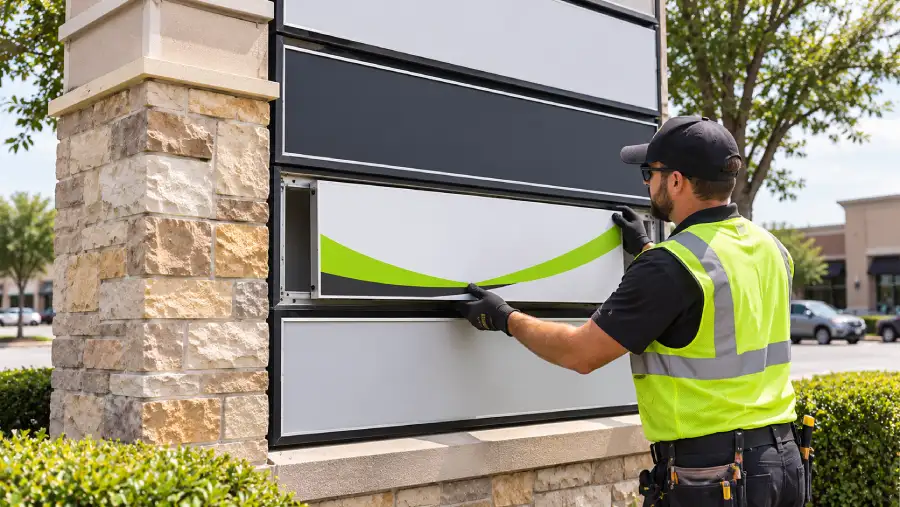
For businesses in shopping centers and office parks, the road sign is usually a shared monument sign or pylon, and your part of it is a single panel. Rebranding that panel is one of the simplest jobs in signage, but it has its own rules.
The landlord controls the structure. You are replacing your panel, not changing the sign, so approval usually goes through property management first.
Panel size is fixed. Your new logo has to work in the existing panel dimensions, often a wide, short rectangle. Logos with a tall icon may need a horizontal version.
Background colors may be set. Many centers require every tenant panel to share a background color so the sign looks unified. Your brand color may end up on the copy, not the background.
Panels come out in a standard way. On most monuments the panels slide or clip into a frame, so the swap itself is quick once the new panel is made.
If you own the property and the monument is yours, a rebrand is also a chance to refresh the whole sign: new panels, new address numbers and a lighting upgrade, without touching the base.
A Rebrand Checklist for Every Sign You Own
The most common rebrand mistake is not a bad reface. It is updating the road sign and forgetting everything else, so customers drive in under the new name and walk into a lobby with the old one. Here is the order we recommend:
Inventory every sign. Road sign, building letters, door vinyl, window graphics, lobby sign, room and ADA signs, wayfinding, and printed items like banners and A-frames.
Check the structures first. Decide reface or replace for each exterior sign using the table above.
Clear permits and landlord approval. Start this the same week as design, because approvals are the slowest step.
Exterior signs go first. They are what new customers see, and they take the longest to make.
Then the lobby and interiors. A new lobby sign and updated ADA room signs if the brand colors or fonts appear on them.
Then vinyl. Door hours, window graphics and wall graphics are the quickest items, so they can be timed to launch day.
Schedule the swap so the gap is short. Ideally, old signs come down and new faces go up in the same visit.
Frequently Asked Questions
What is sign refacing?
Sign refacing is replacing the face of an existing sign, the part that carries your name and logo, while keeping the cabinet, structure and wiring. It is the usual way to update a sign after a rebrand, a new tenant or sun fading when the structure is still in good shape.
Is it cheaper to reface a sign than to replace it?
Usually, yes. A reface skips the structure, foundation and most of the installation work that make new signs expensive. The savings shrink if the reface also needs new lighting, structural repairs or a custom face, so it is worth pricing both options.
Do you need a permit to reface a sign in DFW?
It depends on the city and the scope. Irving requires a permit even for sign repairs, while other cities may treat a face change differently than a structural change. Any lighting work usually needs an electrical permit, and leased spaces need landlord approval first.
Can you reface channel letters?
Yes, if the new design uses the same letter shapes. Channel letters can get new faces and trim cap on the existing returns. A new business name almost always means new letters, though the raceway or mounting can sometimes be reused.
Can an old sign be converted to LED during a reface?
Yes, and it is the best time to do it because the face is already off. Fluorescent and neon cabinets can usually take LED modules, but the face and the LED layout should be planned together to avoid hot spots.
Will replacing an old sign make it smaller?
It can. If your current sign is larger than today's code allows, it may be protected as a nonconforming sign, and a full replacement may have to meet current limits. Refacing often keeps the existing size, so check the sign's status before you tear it down.
Keep What Works, Replace What Doesn't
A rebrand does not have to mean starting every sign from scratch. Check the structure, check the lighting, check whether the new logo fits, and find out whether your current sign is protected before anything comes down. If you want help sorting that out across all your signs, request a free estimate and we will tell you which ones can be refaced and which ones are due for replacement. For new building signs, see our exterior building signage services.
Implementation notes
The post links out to 6 money pages and 2 city pages; add the 3 inbound links below after publishing so the post does not sit as an orphan.