





Signage Standards for Multi-Tenant Commercial Properties in DFW
A shopping center with twelve tenants and no sign rules ends up with twelve different ideas of what a sign should look like. One tenant installs a lit cabinet box, the next hangs a vinyl banner that stays up for two years, and the pylon panels fade at different rates until the street sign looks like a patchwork.
Multi-tenant signage standards fix that. They are the written rules a property owner sets for every tenant sign on the property: which sign types are allowed, how big they can be, how they're lit, where they mount, and how a tenant gets approval before anything is fabricated. For DFW owners and property managers, clear standards protect the look of the center, cut the back-and-forth on every new lease, and make tenant turnover a lot less painful.
Key Takeaways
|
Table of Contents
What Are Multi-Tenant Signage Standards?
Why DFW Properties Need Written Sign Criteria
What a Real DFW Sign Criteria Document Looks Like
What Your Signage Standards Should Cover
Common Gaps in Tenant Sign Criteria
How Tenant Sign Approval Should Work
Landlord Approval and City Permits Are Separate
When to Update Your Signage Standards
Frequently Asked Questions
What Are Multi-Tenant Signage Standards?
Multi-tenant signage standards are the property-level rules that govern every tenant sign on a shared commercial property, and they're usually attached to the lease as an exhibit. You'll also see them called tenant sign criteria, sign criteria, or a sign program. Tenants follow them on top of whatever the city sign code requires.
It helps to separate the layers people tend to blur together. City sign code is the legal floor: what Dallas, Fort Worth, Plano or Arlington will permit on that parcel. A master sign program is the plan for the whole property, covering freestanding signs and the total sign allowance, and in some cities it goes through a formal municipal review. Tenant sign criteria sit inside both and spell out exactly what each tenant can put on its storefront, its pylon or monument panel, and its glass.
A tenant's brand guidelines are the last layer, and that's where most conflicts start. A national brand may want its red cabinet sign; your criteria may only allow individually mounted channel letters. On your property, the criteria decide which one wins, which is exactly why they need to be written down before the lease is signed.
Why DFW Properties Need Written Sign Criteria
Most retail centers, office parks and mixed-use properties around Dallas Fort Worth lease to a mix of national brands, regional franchises and local businesses. Each one shows up with its own sign vendor and its own idea of what's acceptable. Without written criteria, every lease turns into a negotiation over the façade.
Consistency is the obvious payoff. Prospective tenants and shoppers judge a center by its frontage, and a row of matching channel letters reads as a well-run property. A mismatched row reads as the opposite, even if the parking lot is clean and the leasing office answers the phone.
Speed matters just as much. When a new tenant signs, their sign company can design to your numbers on the first try instead of submitting three rounds of drawings. In our experience, approval delays on multi-tenant projects come far more often from vague criteria (phrases like "tasteful" or "appropriately sized") than from strict ones. Strict criteria with clear numbers are easier for everyone to follow.
Then there's liability. Criteria that define insurance, installer licensing, mounting methods and removal responsibilities keep the owner from paying for a damaged fascia, a roof leak at a conduit penetration, or a wall full of bolt holes after a tenant leaves.
What a Real DFW Sign Criteria Document Looks Like
Good standards are easier to write once you've seen a working example. Fidelis Realty Partners publishes the tenant sign criteria for Rayzor Ranch Town Center in Denton, and it's a useful model because nearly every rule is measurable. Here are some of its requirements:
Requirement | Rayzor Ranch Tenant Sign Criteria |
Maximum sign span | 80% of the tenant's storefront width |
Letter height, one line of copy | 14 in. minimum, 36 in. maximum |
Letter height, two lines of copy | Top line 12 to 24 in., bottom line 10 to 12 in., 6 in. between lines |
Sign depth | 3 in. minimum, 5 in. maximum |
Mounting | Raceways prohibited; non-anchor tenants use 2 x 8 in. wire-ways painted to match the façade |
Prohibited sign types | Lighted box or cabinet signs, animated or flashing signs, banners without written landlord consent |
Lighting hours | Dusk to 12:00 a.m., set by the landlord |
Repairs | Tenant fixes a malfunctioning sign within 3 business days |
Entry door graphics | Up to 144 sq. in. of vinyl lettering, no taller than 4 in. |
Source: Rayzor Ranch Phase I Tenant Sign Criteria, Fidelis Realty Partners (frpltd.com).
Notice what's missing: words like "attractive" or "high quality." Every rule can be checked against a shop drawing, so a sign company can confirm compliance before fabrication and a property manager can approve or reject a submittal without a debate. That's the bar to aim for, whether your property has four suites or forty.
The document also handles the unglamorous details. It requires sign companies to carry insurance with the landlord named as certificate holder, puts the cost of removal and building repair on the tenant at the end of the lease, and requires mounting hardware to go through mortar joints rather than the masonry itself. Those clauses rarely get attention until something goes wrong.
What Your Signage Standards Should Cover
Every property is different, but most multi-tenant signage standards need to address the same groups of requirements. Use these as a checklist when you write new criteria or review the ones you inherited with the property.
Approved sign types and construction
List the sign types tenants may use and describe how they're built. Many centers allow front-lit or reverse-lit channel letters and prohibit lit cabinet boxes, because individual letters look cleaner on the façade and age better. Specify face material, return color and finish, trim cap color, and whether letters mount flush, on standoffs, or on a raceway. If you allow a raceway, give its size and require it painted to match the wall.

Size, placement and sign bands
Define the sign band on each building elevation and set a maximum span as a percentage of storefront width, plus minimum and maximum letter heights. Treat corner and end-cap suites separately, since they often get a second elevation sign. Elevation drawings with the sign band marked will settle more disputes than any paragraph of text, so attach them to the criteria.
Lighting and operating hours
State the light source (many criteria now require white LED), whether exposed neon is allowed, and the hours signs must stay lit. Requiring signs to stay on until a set time keeps the center from looking closed at 9 p.m. when half the tenants have switched off. Add a repair deadline so a dead letter doesn't stay dark for months.
Pylon and monument tenant panels
Freestanding signs are shared real estate, so the criteria should control them tightly: panel size, panel material, background color, copy color, and how positions are assigned (by anchor status, by square footage, or by lease terms). Standardize panel dimensions so a replacement panel can be cut and swapped without opening up the whole cabinet. If your multi-tenant monument signs or pylons are aging, a criteria update is a good moment to plan a retrofit at the same time.
Storefront glass, doors and temporary signs
Window graphics are where criteria get ignored most often. Set limits on glass coverage, permitted content (hours, address, phone number), letter height, and whether graphics go on the interior or exterior surface. Address grand opening banners and "coming soon" signs directly, including how long they can stay up, where they go and who approves them. A temporary banner without an end date tends to become permanent.
Directory, suite and wayfinding signs
Tenant standards should reach past the façade. Directory boards, suite numbers, rear service door identification and interior wayfinding signage all need one consistent format so tenants can be added or removed without redesigning the system. Our guide to wayfinding for retail, office and multi-tenant properties covers how to plan that layer. Room and suite identification signs inside buildings also fall under the Texas Accessibility Standards, so include tactile and Braille requirements where they apply.
Installation, insurance and removal
Spell out who can install signs, with electrical work performed by licensed Texas electrical sign contractors. Set insurance requirements and name the landlord as certificate holder. Specify approved fasteners, how penetrations are sealed, and where transformers and power supplies go. Then cover the end of the lease: the tenant removes the sign, patches and paints the fascia, and safely terminates the electrical. Skip this section and you'll eventually inherit a wall of empty bolt holes between tenants.
Common Gaps in Tenant Sign Criteria
Most problems we see with existing criteria aren't about rules that are too strict. They're about rules that are missing or too loose to enforce.
Vague language. "Signs must be tasteful and consistent with the character of the center" gives your property manager nothing to enforce and gives a tenant plenty of room to argue. Replace adjectives with dimensions, colors and materials.
No plan for turnover. Criteria written for opening day often ignore what happens when suite 104 changes hands. Panel sizes, patching standards and a deadline for removing the old sign belong in the document.
Outdated requirements. Criteria still written around neon, or that conflict with a sign ordinance the city updated after the center opened, lead to landlord approvals the city won't permit.
No exception process. Some tenants will need a variance, especially national brands with strict brand standards. Describe how to request one and who decides, so exceptions are documented and don't quietly become the new norm for everyone else.
Criteria that never reach the sign company. Standards only help if the tenant's sign vendor sees them before design starts. Send them with the lease and again when the tenant requests sign approval.
How Tenant Sign Approval Should Work

A predictable approval process protects both sides. Tenants know what to submit and when they can open, and the owner gets a sign that matches the criteria. A workable sequence looks like this:
Deliver the criteria with the lease, along with elevation drawings showing the tenant's sign band and any panel position on the pylon or monument.
The tenant's sign company submits shop drawings with dimensions, letter heights, colors and materials, lighting method, mounting details and the electrical connection.
The property manager reviews the drawings against the criteria and returns a written decision: approved, approved with comments, or rejected. A quick "looks good" email shouldn't count.
The sign company applies for the city sign permit using the approved drawings.
Fabrication starts only after both the landlord approval and the city permit are in hand.
After installation, the property manager walks the site to confirm the sign matches the approved drawings.
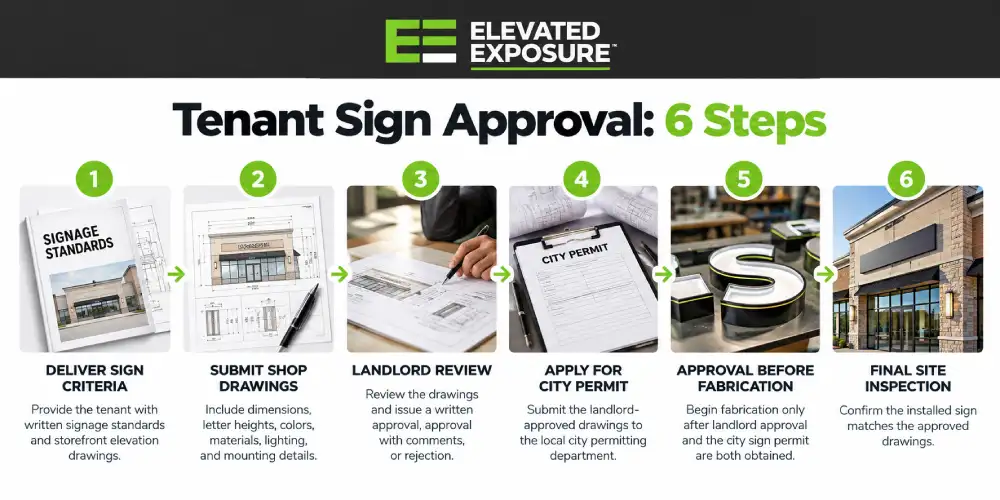
Putting a review deadline in the criteria, such as ten business days, helps tenants plan their opening date and keeps submittals from sitting in an inbox.
Landlord Approval and City Permits Are Separate
A landlord's signature doesn't replace a city sign permit, and a city permit doesn't override the lease. Tenants need both. Your criteria can be stricter than the city code, but they can't authorize something the code prohibits.
Each DFW city sets its own sign regulations, and the process in Dallas isn't the same as the one in Fort Worth, Frisco or Arlington. Our Dallas sign permit guide and Fort Worth sign permit guide walk through the local steps. When you write or update criteria, check them against the current code for your city so you don't approve a sign the city will reject.
When to Update Your Signage Standards
Review your criteria when the property is renovated or repainted, when an anchor tenant changes, when you replace the pylon or monument, and when the city updates its sign ordinance. Even if none of that happens, put a revision date on the document and look at it every few years.
Criteria that match the building's current colors and the current code get followed. Criteria that clearly date from another decade get ignored, and once tenants learn they can ignore one rule, the rest go with it.
Frequently Asked Questions
What are tenant sign criteria?
Tenant sign criteria are the rules a landlord sets for every tenant sign on a commercial property, usually attached to the lease as an exhibit. They cover sign types, size, lighting, materials, placement and the approval process. Tenants must follow them in addition to the city's sign code.
Do I need landlord approval if the city already issued a sign permit?
Yes. Landlord approval and a city sign permit are separate, and most leases require written landlord approval before a sign is installed. Many property managers prefer to approve drawings before the tenant applies for the permit, so the permit drawings match what the landlord accepted.
Can sign criteria override a tenant's brand standards?
On the property, yes. The lease and its sign criteria control what a tenant can install, so a brand may need to use an approved alternate version of its sign. National tenants sometimes negotiate exceptions during lease negotiations, which is the right time to raise them.
Who pays for sign removal when a tenant moves out?
That depends on the lease, but well-written criteria put removal, fascia repair and painting on the departing tenant. If your current criteria don't say this, add it before the next lease is signed.
How long does landlord sign approval take?
It depends on the property and how complete the submittal is. A clean submittal that follows written criteria can be reviewed within days, while vague criteria or missing details can stretch the process to several weeks. Putting a review timeline in the criteria helps everyone plan.
What is the difference between a master sign program and tenant sign criteria?
A master sign program covers signage for the entire property, including freestanding signs and the overall sign allowance, and some cities review it as part of development approval. Tenant sign criteria are the more detailed rules for each tenant's storefront, panel and window signs within that program.
Need Help Writing or Updating Your Sign Criteria?
Elevated Exposure Signs and Graphics works with property owners, developers and managers across Dallas Fort Worth on commercial property signage, from multi-tenant monuments and pylon panels to storefront channel letters and wayfinding. If your criteria are out of date or you're preparing a new center for lease-up, we can review what you have and help you build standards tenants will actually follow. Book a consultation to talk through your property.
Related reading: Channel Letter vs. Monument Signs in DFW and Window and Wall Graphics for DFW Storefronts and Offices.