


Custom Branded Lobby Signs: 7 Ways to Make a Powerful First Impression in Your Office
Key Takeaways
A custom lobby sign is a logo or company-name sign designed, fabricated, and mounted for one specific reception wall, built from materials like acrylic, brushed aluminum, stainless steel, or PVC, with or without LED lighting.
Acrylic and standoff signs are the most budget-friendly. Dimensional metal and halo-lit letters read as more established.
Size the sign to the wall and the viewing distance, not to your logo file.
Your wall type (drywall, glass, or concrete) changes the mounting hardware and the install cost.
Company names and logos are exempt from ADA sign rules, but suite and room signs in the same lobby are not.
Lighted signs need power at the wall, and in Texas that electrical work falls under state licensing.
When a customer, employee, vendor, or investor walks through your front door, they begin forming an opinion about your business within seconds.
Before they speak with your team. Before they see your products. Before they experience your service.
Your lobby sign is often the first thing they notice.
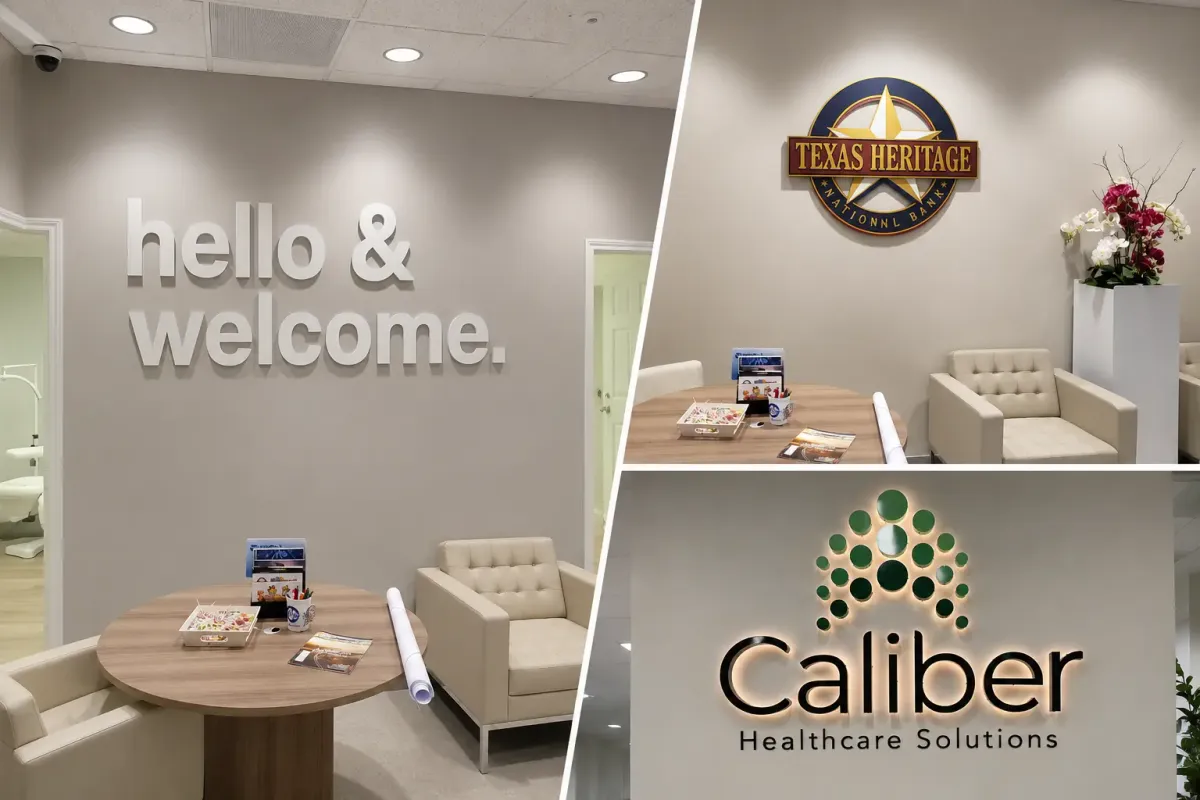
A professionally designed custom lobby sign immediately communicates credibility, professionalism, and attention to detail. Whether you need corporate office signage, you're a medical practice, fitness center, law firm, nonprofit, school, or retail headquarters, the right lobby sign helps reinforce your brand and create a memorable experience.
At Elevated Exposure Signs and Graphics, we help businesses throughout Dallas-Fort Worth create custom interior signage that transform ordinary reception areas into branded environments.
Why Lobby Signs Matter
A lobby sign does much more than display a logo.
It helps:
Build trust with visitors
Reinforce brand recognition
Create a polished professional appearance
Improve customer confidence
Strengthen company culture
Enhance office aesthetics
Provide a social-media-worthy backdrop for photos
Businesses often spend thousands of dollars on marketing and advertising, yet overlook one of the most visible branding opportunities inside their own building.
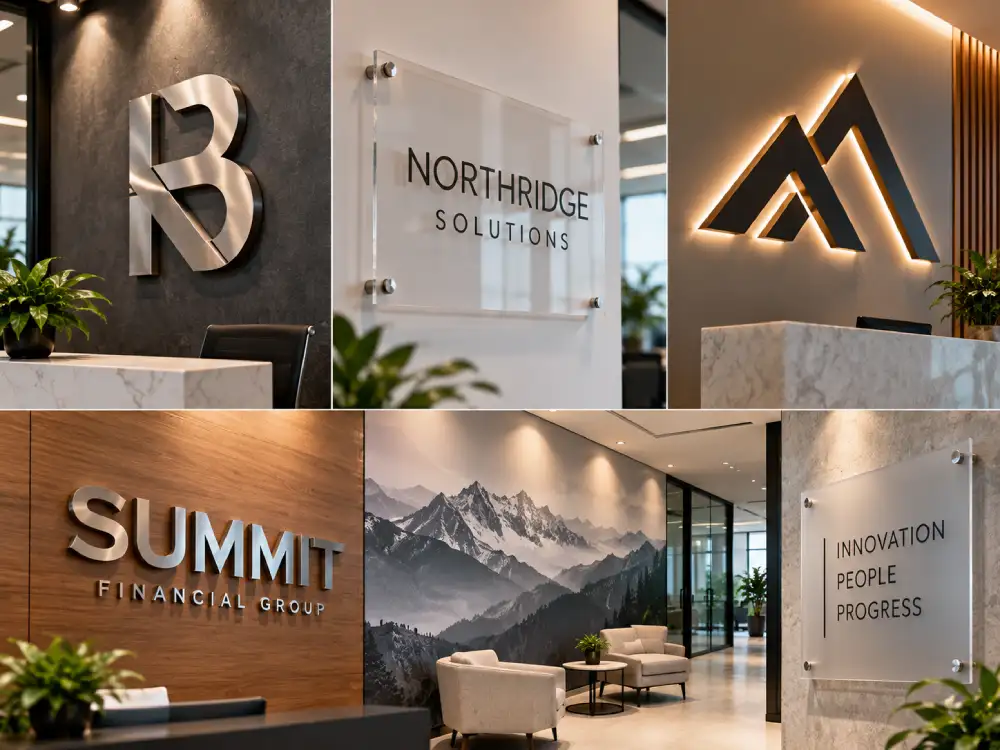
1. Dimensional Letter Lobby Signs
Dimensional lettering remains one of the most popular lobby sign options.
These signs use individual letters and logos fabricated from materials such as:
Acrylic
PVC
Metal
Aluminum
Brushed stainless steel
Brass
Dimensional signs create depth and shadowing that make logos stand out from the wall.
Best for:
Corporate offices
Financial institutions
Medical offices
Professional service firms
2. Acrylic Logo Signs
Acrylic lobby signs provide a clean, modern appearance and can be customized with:
Painted backs
Frosted finishes
Printed graphics
Layered elements
Standoff mounting
Many growing businesses choose acrylic because it delivers a premium look while remaining budget-friendly.
Best for:
Startups
Technology companies
Real estate firms
Coworking spaces
3. Illuminated Lobby Signs
Want maximum visual impact?
Illuminated lobby signs create a sophisticated appearance by incorporating LED lighting behind or within the sign.
Popular options include:
Halo-lit signs
Backlit acrylic logos
Edge-lit acrylic panels
LED channel letters
These signs create a high-end atmosphere and often become a focal point within the office.
Best for:
Corporate headquarters
Luxury brands
Hospitality spaces
Executive suites
4. Metal Lobby Signs
Metal signs offer a timeless and upscale aesthetic.
Common materials include:
Brushed aluminum
Stainless steel
Bronze
Brass
Metal signage is especially popular among businesses seeking a professional and established appearance.
Best for:
Law firms
Wealth management firms
Engineering companies
Executive offices
5. Environmental Branding Walls
Many organizations are moving beyond traditional logo signs and creating full branded environments.
This may include:
Wall graphics
Company mission statements
Brand storytelling
Historical timelines
Recognition walls
Corporate values displays
These installations transform a lobby from a waiting area into an immersive brand experience.
Best for:
Corporate campuses
Educational institutions
Nonprofits
Healthcare organizations
6. Reception Signs with Standoffs
Acrylic signs mounted with decorative standoffs create a modern floating appearance.
Benefits include:
Easy installation
Professional appearance
Custom sizing
Cost effectiveness
This remains one of the most requested lobby sign styles for businesses looking to maximize visual appeal without investing in illuminated signage.
7. Multi-Layered Logo Signs
Layered signage combines multiple materials to create a premium, dimensional effect.
Examples include:
Acrylic over brushed aluminum
Raised logos over printed panels
Layered color elements
Mixed metal and acrylic construction
These signs offer a custom appearance that helps businesses stand out from competitors.
How Big Should a Custom Lobby Sign Be?
Once you know which style fits your brand, the next decision is size, and it is where most lobby sign projects go wrong. A logo that looks bold on a laptop screen can feel lost on a 20-foot accent wall. An oversized sign squeezed between a door frame and a wall-mounted TV feels like a billboard in a hallway.
A practical starting point is to have the sign fill roughly 40 to 60 percent of the visible wall width behind the reception desk. That leaves enough empty wall on each side to frame the logo. In a typical office suite, that lands somewhere between 3 and 6 feet wide.
Viewing distance matters just as much as wall width. Judge the size from the front door, not from the reception desk, because that is where a visitor first reads your name. Dimensional letters between 4 and 12 inches tall cover most interior viewing distances, and a tagline can run smaller as long as it stays readable from the entrance.
Three things in the room can change the right size:
Ceiling height, soffits, or bulkheads above the desk
Light switches, thermostats, and HVAC registers on the sign wall
Furniture, plants, or monitors that block the lower third of the wall
Before fabrication, we recommend taping a full-size paper template to the wall. It costs almost nothing and settles sizing debates in about five minutes. If you are still choosing between build styles, our comparison of dimensional letters vs. flat-cut acrylic signs breaks down how each one reads at different sizes.
How Lobby Signs Are Mounted on Drywall, Glass, and Concrete
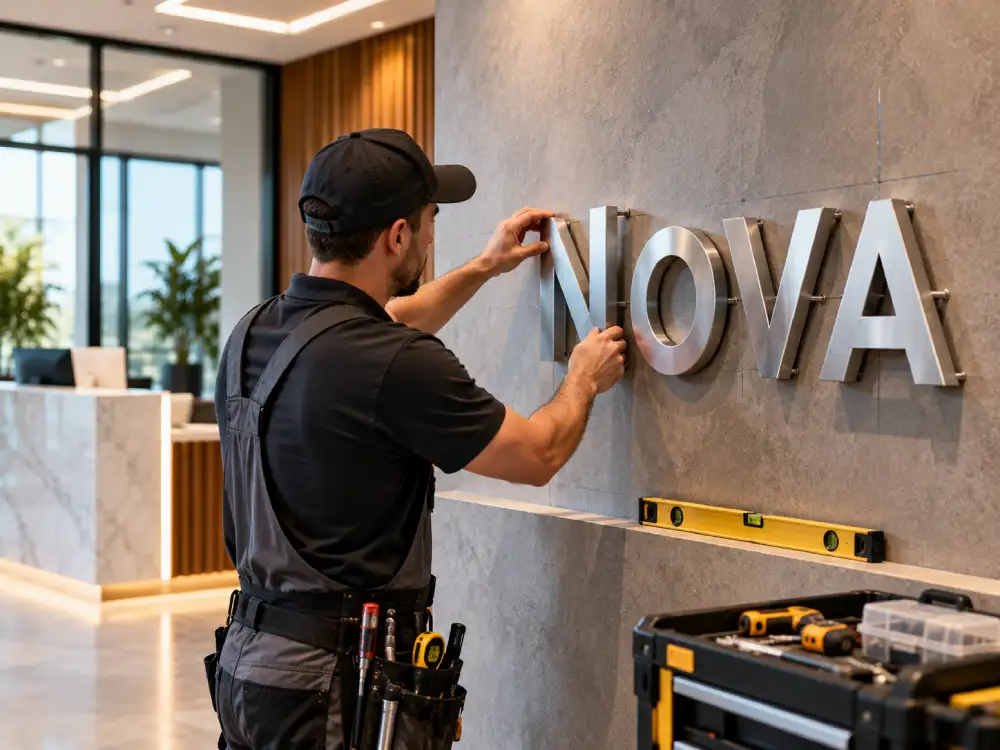
The wall behind your reception desk decides how your sign gets installed, and that choice affects both the cost and how long the sign stays perfectly level.
Drywall: the most common surface. Lightweight acrylic panels and PVC letters mount with standoffs or threaded studs into rated anchors. Heavier metal letters hold best when they land on a stud or on wood blocking added during a build-out.
Glass: popular in newer office towers and creative suites. Signs mount with clear standoffs through drilled glass, glass clamps, or structural tape. Many companies add a frosted vinyl band behind the logo so it stays readable against the room behind it.
Concrete, brick, or stone: common in tilt-wall and converted industrial spaces around DFW. These walls need masonry anchors and drilling, which adds labor but gives the strongest hold.
Wood slat or accent panels: they look great, but the layout has to be planned so every mounting stud lands on solid material instead of a gap.
Standoff mounting is a method that holds a sign panel off the wall on metal posts, creating a shadow line that makes the sign look like it floats.
Lighted signs add one more step: power at the sign wall. Halo-lit and backlit signs need an electrical box, a low-voltage power supply, and usually a small wall opening for wiring. In Texas, electrical sign work is licensed by the Texas Department of Licensing and Regulation (TDLR), so we coordinate that connection with licensed electrical sign contractors. If you are building out a new suite, ask your general contractor to rough in power behind the reception wall now, even if the lit sign comes later.
Curious what install day looks like? Here is what to expect during a commercial sign installation. Wall type also feeds directly into price, which is the next question most clients ask.
Do Lobby Signs Need to Be ADA Compliant?
Your logo sign does not, but other signs in the same lobby probably do. Under the 2010 ADA Standards for Accessible Design, company names and logos are specifically exempt from the signage requirements in Section 216. That gives you full creative freedom on the main lobby sign: script fonts, polished metal, layered acrylic, and lighting are all fair game.
The exemption stops at the logo. Signs that identify permanent rooms and spaces, such as suite numbers, restrooms, and conference rooms, must meet Section 703. These are the requirements that trip people up most often:
Tactile characters mounted between 48 and 60 inches above the finished floor, measured to the baseline of the characters
Raised characters at least 1/32 inch above the background, paired with Grade 2 braille
A non-glare finish with strong contrast between the characters and the background
That last rule matters for branding. A suite sign in high-gloss metal that matches your lobby logo can look great and still fail an accessibility review. We usually design the logo sign and the room signs as one package, so finishes and colors match while each piece follows its own rules. Our ADA compliant signage team in DFW handles both.
Choosing the Right Lobby Sign
Before selecting a sign, consider:
What impression do you want visitors to have?
Is your brand modern, traditional, innovative, or luxurious?
Will visitors take photos in the space?
Does the sign need illumination?
Will the lobby be renovated in the future?
A well-designed lobby sign should align with your overall branding strategy and complement the architecture of your space.
How Long Does a Custom Lobby Sign Project Take?
Most non-lighted lobby signs take about two to four weeks from the first conversation to installation. Lighted signs and larger branded walls usually run longer because of electrical coordination and more involved fabrication. Here is how the process typically flows:
Site visit and measurements: we measure and photograph the wall, note the surface type, and check for power.
Design and proof: you approve a digital mockup that shows the sign at scale on a photo of your actual wall.
Landlord or property manager approval: many multi-tenant buildings in Dallas and Fort Worth require sign-off before anyone drills into common walls or glass.
Fabrication: cutting, painting, and assembly, plus LED installation for lit signs.
Installation: most interior lobby signs install in a few hours, often before or after business hours so your front desk stays open.
Step three is the one that most often adds time. If you lease your space, send the mockup to your property manager as soon as you have it, and check whether your building has written multi-tenant signage standards for finishes and placement.
5 Lobby Sign Mistakes That Weaken a First Impression
A good lobby sign can still underperform once it is on the wall. These are the problems we see most often, and every one of them is easy to prevent during design.
Low contrast. White acrylic on a white wall, or brushed silver on light gray paint, disappears from the doorway. A darker backer panel, an accent wall color, or a halo glow fixes it.
Glare from overhead lights. Polished metal and gloss acrylic can bounce recessed lighting straight into a visitor's eyes. Brushed or satin finishes, or a small change to the light angle, solve the problem.
Competing with the room. A sign placed next to a wall-mounted TV, large artwork, or busy wallpaper loses the fight for attention. Give the logo its own wall.
Starting from a low-resolution logo. Fabrication needs vector artwork (AI, EPS, or PDF). And if a rebrand is on the horizon, finish it first, because replacing a sign six months after install is the most expensive mistake on this list.
Skipping power planning. Plenty of businesses start with a non-lit sign and later want a halo glow. If the wall was never wired, that upgrade means opening finished drywall.
Avoid these and even a modest acrylic sign will look intentional. Want to see what works in real reception areas? Browse our project portfolio for lobby signs we have built across DFW.
Final Thoughts
Your lobby sign is more than décor, it's one of the most powerful branding tools inside your facility.
The right sign communicates professionalism, reinforces your identity, and creates a positive first impression that lasts long after a visitor leaves.
Whether you're opening a new office, renovating an existing space, or refreshing your brand, investing in a custom lobby sign is one of the most effective ways to elevate your customer experience.
Custom Lobby Signs: Frequently Asked Questions
What is the best material for a lobby sign?
The best material depends on your brand and your wall. Brushed aluminum and stainless steel suit firms that want to look established, while acrylic offers the most color and finish options at a lower price. PVC is a smart choice for large letters where weight is a concern.
What is the difference between halo-lit and face-lit lobby signs?
A halo-lit sign has LEDs behind solid letters that wash light onto the wall, creating a glowing outline while the letter faces stay dark. A face-lit sign shines light through translucent acrylic faces, so the letters themselves glow. Halo lighting reads as subtle and upscale, while face-lit letters are brighter and easier to read across a large room.
Can a lobby sign be mounted on glass?
Yes, a lobby sign can be mounted on glass with clear standoffs through drilled holes, glass clamps, or structural adhesive. Many businesses add a frosted vinyl panel behind the logo so it stays readable against whatever is behind the glass. In a leased suite, get your property manager's approval before any glass is drilled.
How long does a custom lobby sign last?
An indoor lobby sign usually lasts many years because it is protected from sun, rain, and Texas heat. Metal letters can hold their finish for well over a decade, while acrylic may show scratches or fading near sunny windows over time. On lighted signs, the LED power supply is the part most likely to need replacement.
Do I need landlord approval to install a lobby sign?
In most leased office spaces, yes. Commercial leases commonly require written approval before tenants drill into walls, glass, or shared areas, and many buildings set their own rules for sign finishes and placement. For exterior signs, city rules apply too, which we cover in our guide to sign permits in Dallas and Fort Worth.